
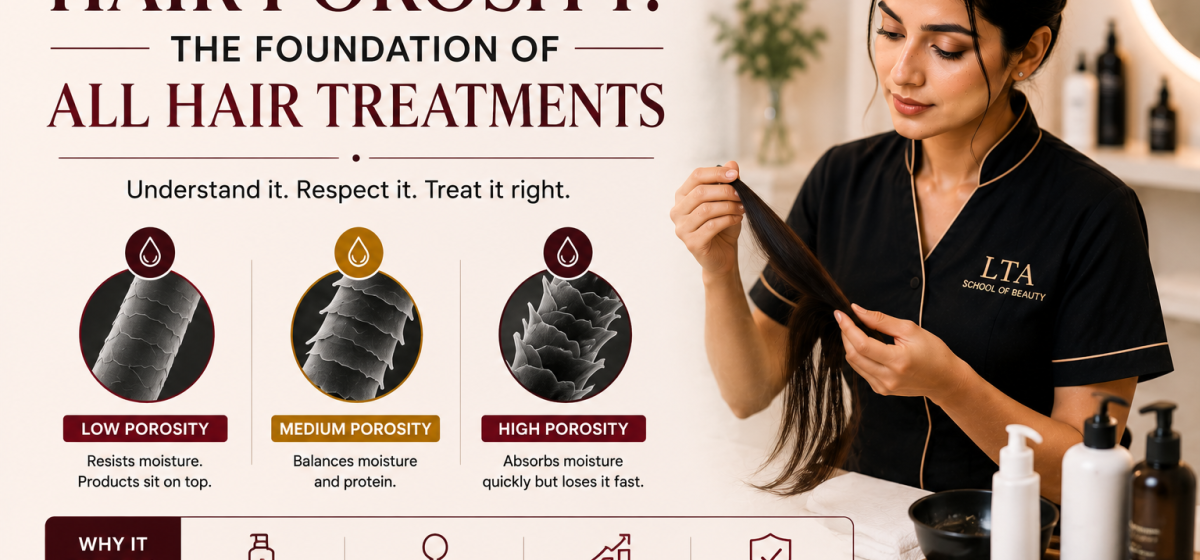
Your client’s hair health depends on more than about suggesting the right treatment and products. One of the most commonly overlooked yet very important part of haircare is hair porosity. Whether you want to build a career in styling or you’re opting for cosmetology, understanding this concept is step one to recommending suitable products and personalised treatments, and achieving better results.
What Is Hair Porosity?
It is the hair’s ability to absorb and retain moisture. It largely depends on the condition of hair cuticle, which is the outermost protective layer of hair shaft.
The Role of the Hair Cuticle
You can compare hair cuticle with overlapping roof shingles. When this protective covering lies flat, isn’t not easy for moisture to enter hair shaft. But, when it does, it stays locked in. This is low porosity.
On the other hand, when these cuticles are raised or damaged, water enters and escapes the hair very easily. This is high porosity.
Once a professional understands how cuticles behave and what porosity is, they can easily recommend helpful products and treatments to the clients, based on type of hair.
Why Hair Porosity Matters
Every person’s hair responds differently to shampoos, conditioners, masks and chemical treatments. Hair porosity plays a major role in how effectively these products perform.
Knowing a client’s hair porosity can help beauty professionals:
- Recommend suitable hair care products.
- Improve the effectiveness of colouring, smoothening and conditioning treatments.
- Reduce unnecessary hair damage.
- Create personalised hair care routines.
- Enhance long-term hair health.
Instead of using a universal approach for all, understanding porosity helps you tailor the treatment for each client, building trust and authority.
Understanding The Three Types of Hair Porosity
Hair porosity falls into three broad categories: low, medium, and high. Let’s understand them better.
Low Porosity Hair
Hair with low porosity has tightly closed cuticles. It makes it difficult for moisture and even products to penetrate to the hair.
Common characteristics include:
- Water sits on the hair and does not get absorbed quickly
- Hair takes a long time to get fully drenched
- Product build-up is common
- Hair also dries slowly
For such hair. lightweight products and gentle heat during deep conditioning help with moisture absorption.
Medium Porosity Hair
Medium porosity hair means hair has slightly raised cuticles. It allows moisture to enter and stay balanced.
People with medium porosity often notice:
- Healthy shine
- Better moisture retention
- Styling the hair is easier
- Good response to most hair treatments
This is actually considered the ideal hair porosity because it maintains a healthy moisture balance with minimal effort.
High Porosity Hair
High porosity hair has open or damaged cuticles, allowing moisture to enter quickly but escape just as fast.
Common signs include:
- Dryness and frizz
- Frequent tangles and knots
- Split ends appear faster
- Hair absorbs products rapidly but still feels dry or rough
High porosity may occur naturally, like in curly mane, or result from excessive heat styling, bleaching or chemical processing. Rich conditioners, protein treatments and leave-in products can help strengthen and protect the hair.
How to Determine Hair Porosity
Mostly, professionals determine hair porosity through physical observation. However, here’s a simple at-home test that everyone can use:
Take a clean strand of hair and drop it in a glass of water. You will see the following results:
- The strand floats: Low porosity hair
- Strand stays suspended in the middle: Medium porosity hair
- It sinks quickly: High porosity hair.
While this test gives a general idea, a professional hair analysis can help in achieving an accurate understanding of porosity and product/treatment needed.
Choosing the Right Care Based on Porosity
Understanding the hair behaviour is the first step towards finding a successful hair care regime.
- Low porosity: Lightweight moisturising products that prevent product build-up
- Medium porosity: Balanced routine that maintains hydration and overall hair health
- High porosity: Richer conditioners, regular deep-conditioning treatments and products that seal in moisture.
Using porosity and not trends for selecting products can be an effective way to maintain healthier, stronger and more manageable hair.
Why Every Beauty Professional Should Understand Hair Porosity
If you’re an aspiring hairstylists or beauty professionals, understanding this concept is a crucial skill. It forms the base for everything, be it recommending home-care products or performing professional services like colouring, chemical treatments and deep conditioning.
Instead of treating every client in the same way, this understanding can help you provide personalised solutions that improve both results and client satisfaction.
At LTA School of Beauty, we ensure students understand the science behind hair as well as practical, hands-on training. By building a strong understanding of concepts like hair porosity, future professionals can develop the confidence and expertise needed to deliver exceptional client care throughout their careers.