
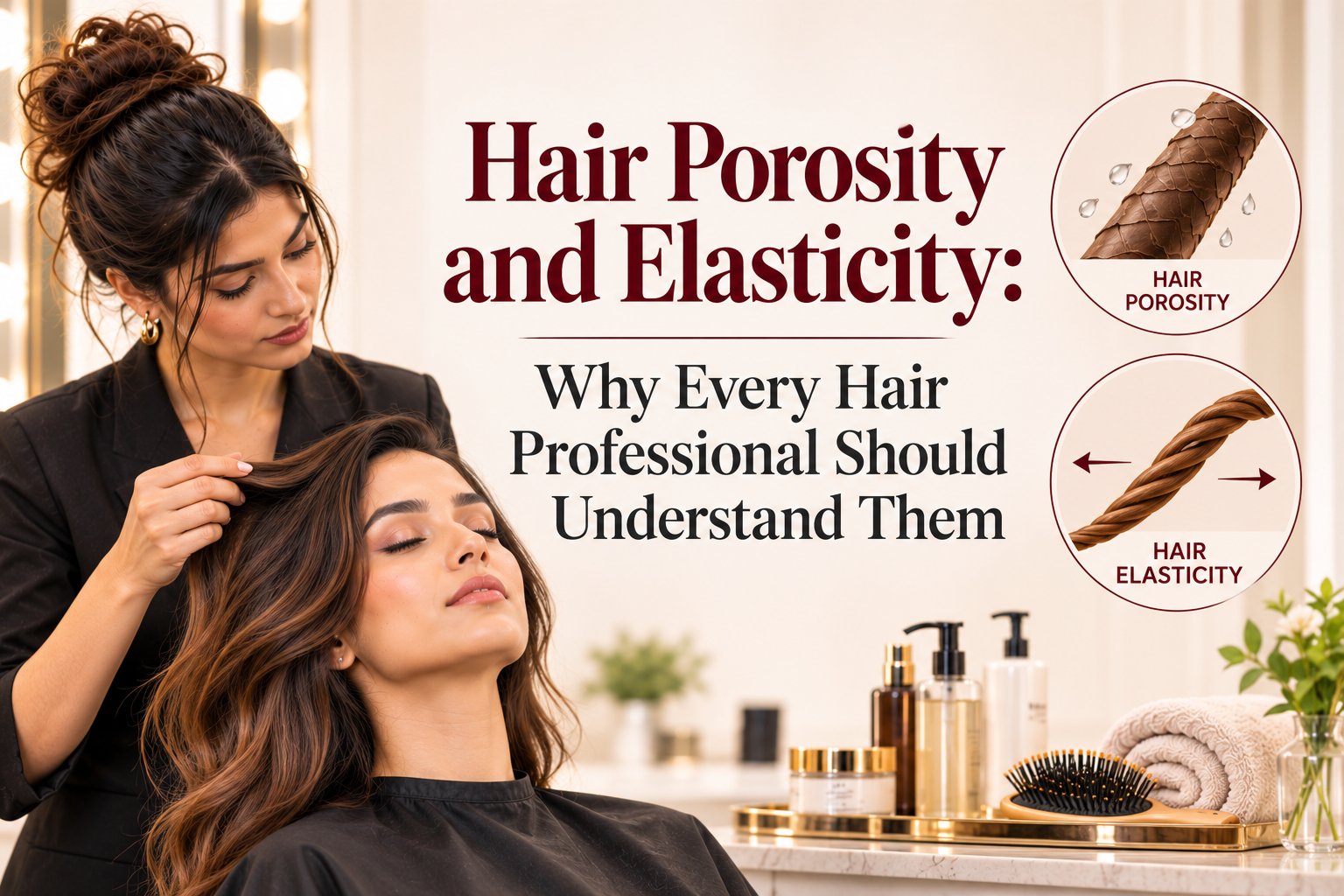
Two clients ask for the same balayage. Both have dark, shoulder-length hair. One leaves with soft, even colour. The other leaves with hair that feels like straw. The difference was not the colour or the stylist’s hands. It was what her hair could handle. So why do hair porosity and elasticity matter? Porosity tells you how well hair absorbs and holds moisture and product. Elasticity tells you how well hair stretches and returns to shape without breaking. Together they show how healthy hair is and whether it can safely take colour, bleach or chemical treatments.
Hair Porosity In One Minute
Our July post on hair porosity covers this in detail, so here is the short version.
Hair is covered in overlapping scales, the cuticle. Porosity describes how open or closed that layer is.
- Low porosity: Tightly closed cuticle. Hair resists water and product, takes longer to get wet and tends to sit on the surface.
- Normal porosity: Cuticle opens and closes well. Hair absorbs and holds moisture reasonably.
- High porosity: Raised or damaged cuticle. Hair soaks up water quickly but loses it quickly too, and often looks frizzy or rough.
Porosity can be natural, but it is also changed by bleach, colour, heat, chemical services, sun and rough handling. That is why hair is often more porous at the ends than at the roots.
What Is Elasticity?
Elasticity is hair’s ability to stretch and then return to its original length. It depends on the strength and condition of the inner structure of the hair, the cortex, which is made of keratin protein and held together by several types of bonds.
Think of a healthy elastic band. It stretches and snaps back. A dry, old one snaps when pulled. An overstretched one goes limp and stays loose. Hair behaves in much the same way.
Healthy hair stretches noticeably when wet and returns to its length. As a rough guide, wet hair can stretch by a good fraction of its length without breaking.
Low elasticity from dryness or brittleness: Hair stretches very little and snaps quickly. It often feels dry and stiff. It usually needs moisture and gentle care.
Low elasticity from over-stretch: Hair feels mushy or gummy when wet, stretches a lot and does not return. This is a sign of serious damage and weakened protein, often from over-processing.
Why Elasticity Matters Before Any Service
Chemical services work by changing hair’s internal structure. If the hair is already weak, the service can push it past breaking point.
- Bleach and lightener lift pigment by opening and altering the hair. They can strip strength fast.
- Colour and developer raise the cuticle and can add stress, especially on repeated applications.
- Smoothening, keratin, rebonding and perms change internal bonds. They need strong hair to hold up.
- Heat styling and tools dry and weaken already fragile hair.
If hair has poor elasticity, a strong service may cause breakage during or after it. Sometimes the right plan is to repair first, and sometimes it is to choose a gentler service.
How To Test Elasticity Safely
Be gentle. The aim is to assess, not to damage.
- Choose a few strands from a hidden area, such as the nape or under the crown, with the client’s permission.
- Test both dry and wet hair, since hair behaves differently when wet.
- Hold a single strand between your fingers and stretch it gently. Do not yank.
- Watch what happens. Does it stretch a little and spring back? Snap quickly? Stretch a lot and stay stretched?
- Test more than one area, such as roots, mid-lengths and ends. They can differ a lot.
- Record the result in your notes.
| What you see | What it suggests | What to consider |
| Stretches slightly, returns to length | Healthy elasticity | Likely able to handle planned service, with care |
| Snaps quickly with little stretch | Dry, brittle hair | Moisture and gentle care first. Be cautious with strong services |
| Stretches a lot, stays stretched or feels gummy | Weak, over-processed hair | Avoid chemical services. Focus on repair and recovery |
| Differs between roots and ends | Uneven damage | Plan sections separately, protect the weakest areas |
A strand test is a guide, not a guarantee. Combine it with the client’s history, the look and feel of the hair and your training.
How To Check Hair Porosity In Practice
Many people mention the “float test,” where a strand is dropped in water to see if it floats or sinks. It is popular, but it is not reliable, since oils, products and air bubbles affect the result. More useful checks include:
- Observe how water behaves on clean, dry hair. Does it bead up or soak in?
- Feel the hair. Rough, snagging cuticles suggest high porosity. Very smooth, slick hair may point to low porosity.
- Watch how it dries. Hair that takes a long time to dry may be low in porosity, and hair that dries very fast may be high.
- Check product behaviour. Does conditioner sit on top, or soak in and disappear?
- Compare sections. Ends are usually more porous than roots.
Reading Hair Porosity And Elasticity Together
Each one tells part of the story. Together they guide your plan.
| Combination | Typical signs | Approach |
| Low porosity, good elasticity | Resists water and colour, strong and bouncy | Allow longer processing or heat where appropriate, use lightweight products and avoid heavy build-up |
| High porosity, good elasticity | Soaks up everything, frizz, but still stretches well | Colour and chemicals may take fast and fade quickly. Use gentle formulas and seal the cuticle afterward |
| High porosity, poor elasticity | Rough, snapping or gummy hair | Treat as damaged. Prioritise repair. Avoid strong chemical services |
| Normal porosity, good elasticity | Balanced, easy to work with | Most services are possible, with standard care |
| Low porosity, poor elasticity | Stiff, brittle, product sits on top | Gentle moisture, careful, light products and cautious service planning |
Moisture And Protein Balance
Many hair problems come from imbalance.
- Too little moisture: Hair feels dry, stiff and brittle and snaps easily. It needs hydration.
- Too little protein: Hair feels weak and overstretched. It needs strengthening.
- Too much protein: Hair feels hard and brittle. It needs moisture.
Treating the wrong problem makes things worse. That is why you diagnose first and then choose products. A strong-looking “repair” treatment is not always the right one.
What Affects Hair In India
- Frequent oiling, which can change how hair feels and how treatments absorb
- Hard water, which can leave mineral build-up and dullness
- Heat and humidity, which add frizz, especially on high-porosity hair
- Home colour and henna, which can complicate results
- Sun and pollution, which weaken the cuticle over time
- Heat styling and repeated chemical services
Ask about all of these during the consultation. See our post on the professional hair consultation.
When To Pause Or Refer
- Hair that snaps easily or feels gummy when wet: Postpone strong chemical services.
- Sudden, heavy hair loss or scalp problems: Suggest a doctor visit.
- A client who insists on a service that is too risky: Explain clearly and offer a safer alternative or a staged plan.
At LTA School of Beauty, students learn to assess hair before choosing any treatment. By understanding how porosity and elasticity affect the way hair responds to colour, heat and chemicals, they are able to plan safe, realistic services and protect the long-term health of their clients’ hair.
FAQs
What is the difference between hair porosity and hair elasticity?
Porosity is how well hair absorbs and holds moisture, which depends on the condition of the cuticle. Elasticity is how well hair stretches and returns to its original length, which depends on the strength of the inner structure. Both help show how healthy hair is.
How do you test hair elasticity?
Gently stretch a few clean strands from a hidden area, both wet and dry. Healthy hair stretches a little and returns. Hair that snaps quickly is brittle, and hair that stretches a lot and stays stretched is weak. Test several areas and record the result.
Can hair with poor elasticity be coloured or chemically treated?
It depends on the degree of damage. Very weak hair may break during or after strong services like bleach, rebonding or smoothening. Many professionals focus on repair first or choose gentler options. Always combine your strand test with the client’s history and your training.
Is the float test a reliable way to check porosity?
Not really. Oils, products and air bubbles can change the result. It is more reliable to observe how hair absorbs water and products, how it feels and how fast it dries, and to compare roots, mid-lengths and ends.