
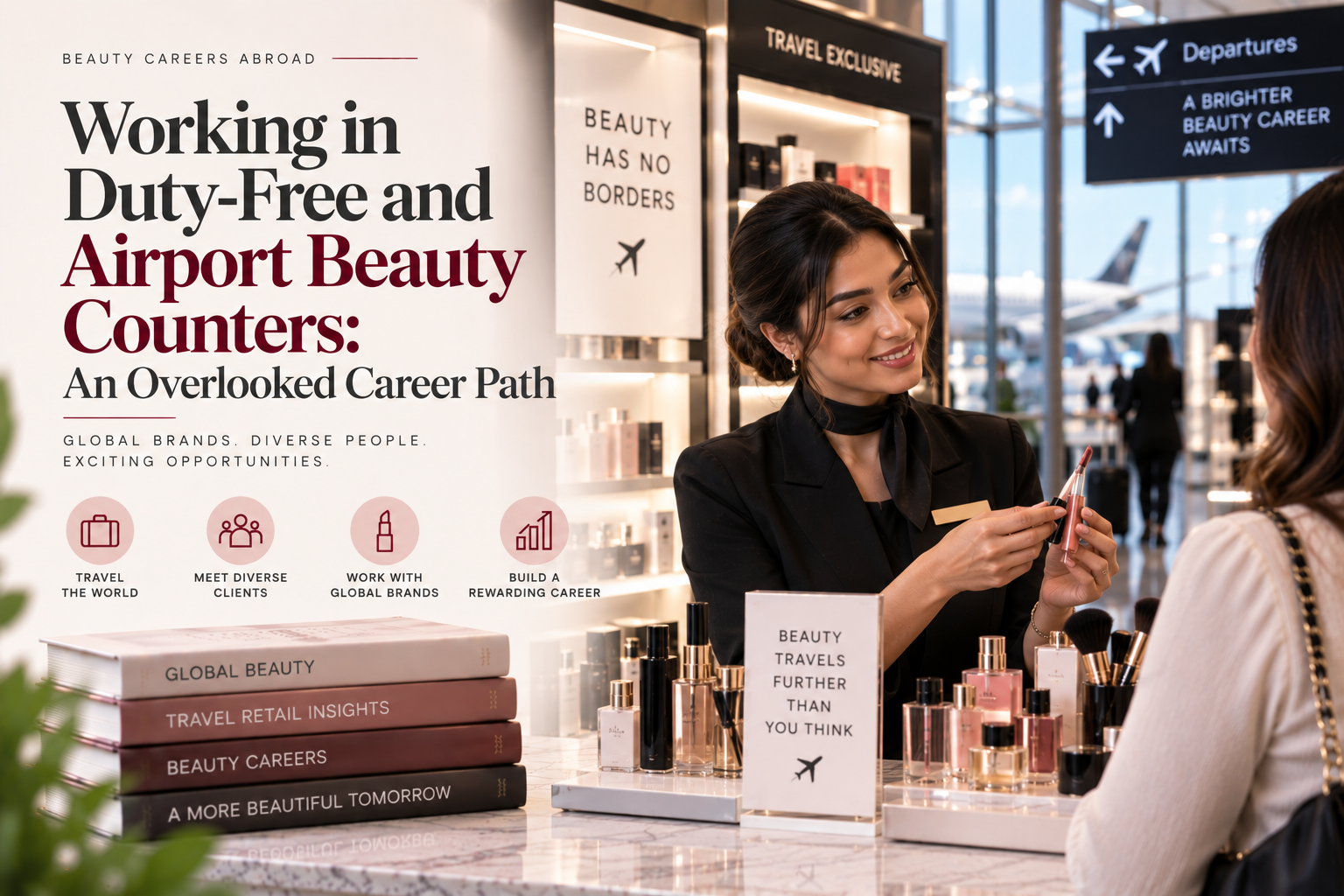
When people think about careers in beauty, the list usually stops at salons, spas, and maybe a bridal makeup business on the side. Airport counters rarely make the list. That is strange, considering how much beauty retail actually happens at 30,000 feet worth of foot traffic every single day. Working in duty-free and airport beauty counters is one of the most overlooked, and honestly one of the most rewarding, career paths for trained beauty professionals. It’s a completely different environment from a salon, and that difference is exactly what makes it worth understanding.
Why Working in Duty-Free and Airport Beauty Counters Gets Ignored
Most beauty students are trained with salons, spas, or freelance bridal work as the end goal. Working in Duty-Free and airport beauty counters rarely comes up in career counselling, for a few reasons.
- It’s retail-coded, not service-coded. People assume it’s just selling perfume and lipstick, not applying beauty expertise.
- It’s less visible. Nobody posts airport counter transformations on Instagram the way they post salon makeovers.
- The hiring happens through beauty brands, not beauty schools. Airbase counters are usually staffed by cosmetic brands like Estée Lauder, MAC, Chanel, or Sephora directly, so the job listings don’t show up where beauty graduates are usually looking.
But look closer at what the job actually involves, and it starts to look a lot more like a specialised beauty consulting role than a retail job.
What the Job Actually Involves
Working an airport beauty counter is a mix of skincare consultation, makeup application, and high-speed customer service, all rolled into one.
- Skin consultations under time pressure. Travellers often want quick, honest skincare advice, what suits dry cabin-air skin, what won’t irritate on a long flight, what’s travel-friendly.
- Makeup application for events. Business travellers heading straight to meetings, or people flying to weddings, often want a quick, camera-ready look done right there.
- Product knowledge across multiple brands. Unlike a single-brand salon job, airport counters often carry several brands, so staff need to know ingredient differences across product lines, not just one.
- Cross-cultural communication. Airports serve an international, constantly changing client base. Staff regularly work with travellers from different countries, skin types, and beauty expectations, all in a single shift.
- High-volume, low-time interactions. A consultation that might take 30 minutes in a salon often has to happen in five, because the client has a flight to catch.
That combination of real expertise, delivered fast, to an international audience is a genuinely demanding skill set, not a lesser version of salon work.
Why Working in Duty-Free and Airport Beauty Counters Is Actually a Strong Career Move
1. Exposure to global beauty trends, faster than almost anywhere else
Airport counters see international travellers first. Staff often notice shifts in product preference, ingredient trends, and regional beauty habits well before those trends show up locally.
2. Direct access to major beauty brands
Airport retail counters are typically run by the brands themselves, which means staff are trained directly by companies like Lancôme, Clinique, or L’Oréal. This is the kind of training that can open doors to brand-side careers later, including training roles, regional beauty advisor positions, or even corporate roles.
3. Strong, structured pay models
Many of these roles run on a base salary plus commission structure, and because airport footfall is high and consistent, commission potential is often better than in a mid-range local salon.
4. A genuinely international resume line
For beauty professionals who eventually want to work abroad, or with international clients, airport retail experience signals comfort working across cultures, languages, and beauty expectations. It’s something salon-only experience doesn’t always show.
What Skills Actually Matter Here
Not every trained beautician thrives in this environment, and it’s worth being honest about what separates the ones who do.
- Speed without losing accuracy. Quick skin assessments still need to be correct, not rushed and wrong.
- Strong product and ingredient knowledge. With multiple brands on one counter, staff need to explain differences clearly and honestly, not just push whatever’s nearest.
- Comfort with constant change. No two shifts look the same. You see different nationalities, different skin concerns, different urgency levels.
- Confidence under pressure. A five-minute consultation with someone about to board a flight needs the same evidence-based reasoning as a 30-minute one, just delivered faster.
Why Solid Skin Science Training Matters Even More Here
In a salon, a stylist has time to build rapport, ask detailed questions, and slowly work out what a client’s skin actually needs. At an airport counter, that entire process gets compressed into a few minutes. There’s no room for guesswork or generic advice, because there’s no time to fix a bad recommendation with a follow-up conversation.
This is exactly why a strong foundation in skin science becomes non-negotiable in this environment, not optional. A professional who deeply understands how active ingredients behave across different skin types can make a fast, accurate recommendation with confidence/. It’s something that simply isn’t possible without real technical grounding.
FAQs
Q: Do you need a cosmetology degree to work at a duty-free beauty counter?
Most brands prefer formal beauty or cosmetology training, since staff need to give accurate skincare and makeup advice quickly, but exact requirements vary by brand and airport.
Q: Are airport beauty counter jobs commission-based?
Many roles combine a base salary with commission on sales, and high footfall at airports often makes commission potential stronger than at many local salons.
Q: What makes airport beauty retail different from salon work?
The pace is much faster, consultations are shorter, and staff usually work across multiple brands rather than specialising in one, requiring broader product knowledge.
Q: Can airport counter experience lead to other beauty industry roles?
Yes. Many professionals use this experience to move into brand training roles, regional beauty advisor positions, or corporate roles within cosmetic companies.