
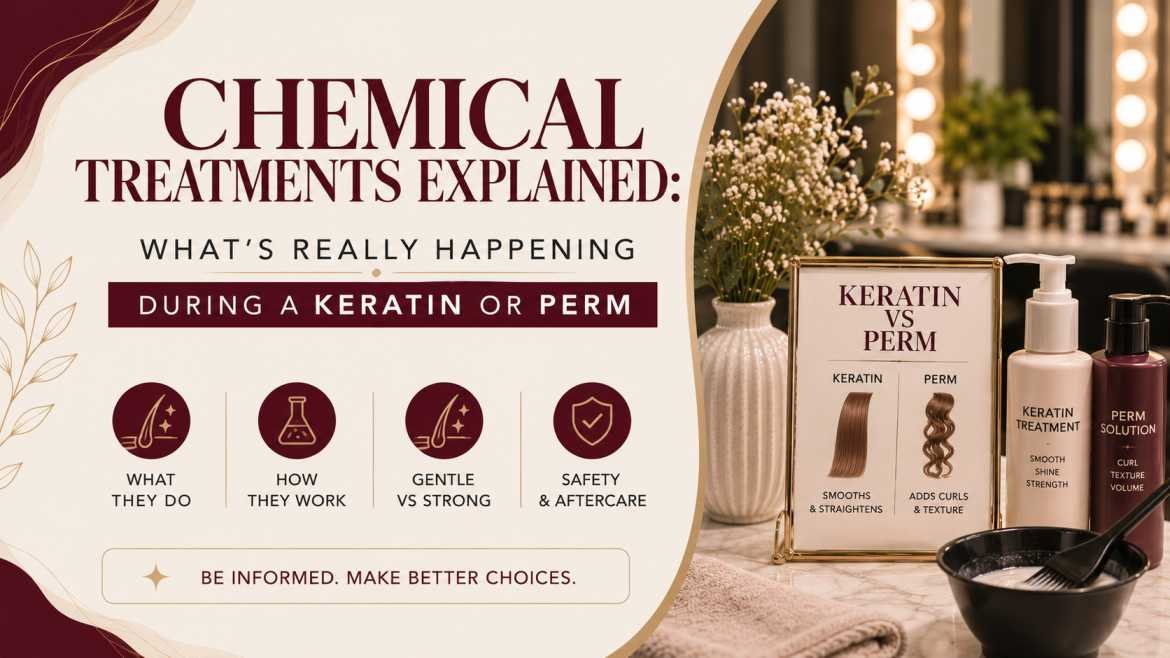
Clients often lump keratin treatments and perms into the same mental category: “the chemical service that changes my hair.” A trained professional needs to think about them very differently, because they work through completely different chemistry, on completely different parts of the hair strand, with completely different results in terms of how long they last. Mixing up the two, or worse, applying them back to back without understanding what each one actually does, is one of the fastest ways to damage a client’s hair. Here’s what’s really happening inside the hair shaft during keratin or perm.
Two Very Different Processes Under One Label
Both keratin treatments and perms get called “chemical treatments,” but they don’t do the same job.
- A keratin treatment smooths and coats the hair, mainly working on the outer structure
- A perm restructures the hair’s internal bonds, changing its shape from the inside out
That difference in depth is exactly why one fades over a few months and the other genuinely doesn’t, until the hair grows out or is cut off.
What’s Actually Happening During a Keratin Treatment
A keratin treatment works mainly through heat and a protein-based formula, not by breaking the hair’s internal structural bonds the way a perm does.
- The formula deposits keratin protein and smoothing agents onto and into the outer layer of the hair shaft
- A flat iron then seals this layer in using heat, which is what creates the smooth, frizz-free finish
- Older keratin formulas relied on formaldehyde or formaldehyde-releasing chemicals to help this bond and last longer, which is also what caused the strong fumes and health concerns linked to this service
- Many current formulas use formaldehyde-free alternatives, such as glyoxylic acid, though results with these can be slightly less long-lasting than the older, higher-formaldehyde versions
- Because the treatment mainly coats and smooths rather than permanently restructures, it fades gradually as the hair grows out and goes through regular washing, usually lasting two to four months
What’s Actually Happening During a Perm
A perm works at a completely different level. It genuinely changes the internal structure of the hair.
- Hair strands are held together partly by disulfide bonds, strong internal chemical bonds that give hair its natural shape and strength
- A perming solution, usually containing a reducing agent like ammonium thioglycolate, breaks these disulfide bonds
- While the bonds are broken, the hair is wrapped around rods to physically reshape it into the desired curl or wave pattern
- A neutralising solution, usually containing an oxidiser like hydrogen peroxide, then reforms the disulfide bonds in this new, curled position
Because the bonds are genuinely re-formed in a new shape rather than just coated, a perm doesn’t wash out the way a keratin treatment does. It stays until the treated hair is cut off or grows out completely.
Why One Fades and the Other Doesn’t
This comes down to depth. A keratin treatment works mainly on the surface and outer layer of the hair shaft. So, ordinary washing and new hair growth gradually remove its effect. A perm changes the actual internal bond structure of the hair itself. There’s no washing routine that reverses a structural change like that. The only way it “grows out” is literally growing new hair that was never treated.
Safety and Consultation Steps Before Either Service
- A patch test at least 24 to 48 hours before the appointment checks for allergic reaction to the formula being used
- Proper ventilation matters significantly for keratin treatments. This is especially true for formaldehyde-containing formulas, to protect both the client and the professional performing the service
- Scalp condition should be checked beforehand. Broken skin, recent colour treatments, or an already compromised scalp can change how a client reacts to either service
- A full service history should be discussed. Recent bleaching, colouring, or other chemical services can affect how the hair responds to a new chemical process
Can You Combine a Perm and a Keratin Treatment?
Not safely, at least not close together. These two treatments work in opposite directions at a chemical level. One smooths and relaxes, the other restructures and curls, and layering them without enough time and recovery in between puts real stress on the hair’s protein structure. Most trained professionals recommend leaving several weeks to months between the two services, and doing a thorough strand test first, rather than assuming the hair can handle both processes back to back.
At LTA School of Beauty, students learn about the science of chemical hair treatments and how to apply them. Through understanding how keratin treatments and perms work at a molecular level, they are able to confidently choose, sequence, and safely deliver services that protect hair rather than damage it.
Frequently Asked Questions
Is a keratin treatment permanent like a perm?
No. A keratin treatment coats and smooths the hair and fades gradually over two to four months. A perm restructures the hair’s internal bonds and lasts until the treated hair grows out or is cut off.
What’s actually different between keratin and perm chemistry?
A keratin treatment mainly works on the outer layer of the hair using heat and protein. A perm breaks and reforms the hair’s internal disulfide bonds, genuinely changing its structure rather than just coating it.
Is formaldehyde still used in keratin treatments?
Some formulas still use formaldehyde or formaldehyde-releasing agents, though many current products use formaldehyde-free alternatives like glyoxylic acid. Proper ventilation remains important regardless of the formula used.
Can you get a perm and a keratin treatment together?
It’s not recommended close together, since the two processes work in opposite directions on the hair’s structure. Leaving weeks to months between the two, with a strand test first, protects the hair from excess damage.