
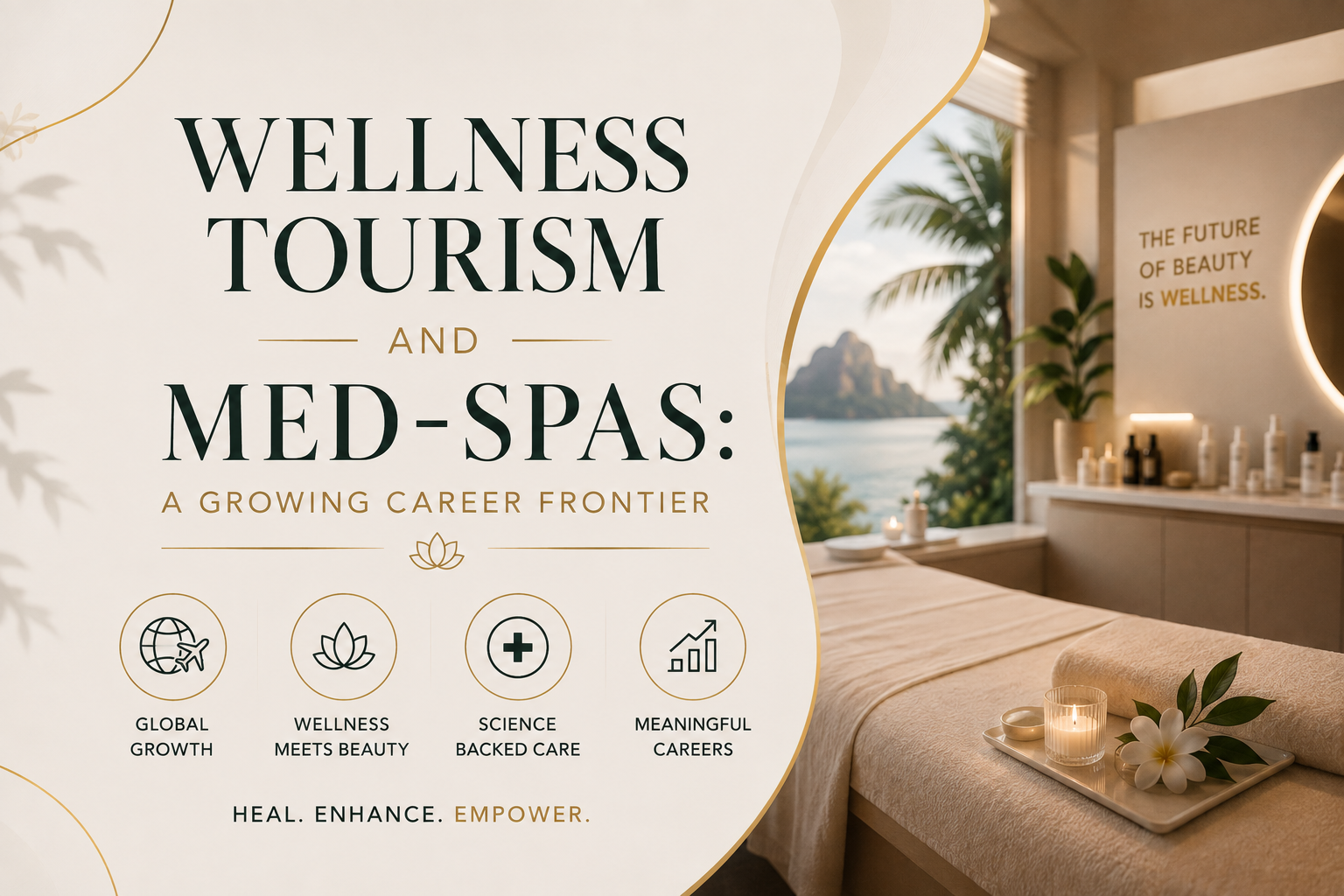
Most beauty students picture their future workplace as a salon or a clinic. There’s a third option growing fast that rarely gets mentioned in career counselling: wellness tourism and med-spas. This isn’t a small, niche corner of the industry. India is one of the fastest-growing wellness tourism markets in the world, and multiple industry reports point to the same problem holding the sector back: a genuine shortage of properly trained staff. That shortage is exactly what makes this a real opportunity for someone finishing a beauty education right now.
Wellness Tourism and Med-Spas Aren’t the Same Thing
These two terms get used loosely, but they describe different kinds of workplaces.
- Wellness tourism means travel specifically undertaken for health and wellbeing, think yoga retreats, Ayurveda centres, detox programmes, and meditation-focused resorts, often over several days rather than a single appointment
- A med-spa sits at the intersection of clinical care and spa-style service, offering treatments like laser hair removal, chemical peels, and injectable procedures, delivered under the supervision of a licensed doctor alongside more traditional spa services
Both are expanding quickly, but they need different skills and offer different kinds of work.
Why This Is Actually a Career Opportunity Right Now
- India’s wellness tourism sector is valued in the tens of billions of dollars and continues to grow steadily year on year, with destinations like Kerala, Uttarakhand, and Goa leading global rankings for wellness travel
- The global med-spa market is growing even faster. It’s expanding at a much sharper rate than the beauty industry overall, driven by rising demand for non-surgical aesthetic treatments
- Government initiatives, including national wellness tourism roadmaps and AYUSH promotion, are actively formalising and investing in this sector. It’s bringing more structured, professional workplaces into the space
- Industry reports specifically flag a shortage of adequately trained wellness and spa staff as a real constraint on this growth, which means demand for trained professionals is currently outpacing supply
What Roles Actually Exist in This Space
- Spa therapist at a destination wellness resort, delivering massage, body treatments, and skincare services to guests staying for multiple days rather than a single visit
- Ayurveda-integrated therapist, trained in traditional treatments like Abhyanga or Shirodhara alongside standard beauty and spa skills, for resorts built around Indian wellness traditions
- Med-spa esthetician, performing treatments like peels, microneedling, or laser services under a supervising doctor’s protocols, working alongside medical staff rather than independently
- Wellness programme staff, supporting structured, multi-day guest programmes that combine fitness, nutrition guidance, and spa treatments into one experience
- Spa training and quality roles at larger resort chains, standardising treatment protocols and training staff across multiple properties
Skills This Space Needs Beyond Standard Salon Training
- Comfort working under medical protocols and alongside doctors is essential for med-spa roles. It’s because these treatments carry more risk and regulation than standard beauty services
- A deeper understanding of contraindications matters more here. Med-spa clients may have skin conditions, medications, or medical histories that affect what treatments are safe
- Hospitality and guest-experience skills matter as much as technical skill in a resort setting. These are often multi-day guest relationships, not quick, transactional appointments
- Exposure to traditional wellness modalities is genuinely valuable for wellness-tourism-focused properties. This is also true for professionals who are primarily experts in modern beauty techniques
How This Career Path Differs From Salon Work
- Many resort and wellness-property roles include accommodation as part of the position, since properties are often located outside major cities
- Client relationships are longer and deeper within a single stay. Guests often check in for multi-day programmes rather than a single forty-five-minute appointment
- Med-spa work usually means being part of a clinical team, working alongside doctors and nurses, rather than working independently on a salon floor
- Work can be seasonal or location-dependent, particularly in tourist-heavy wellness destinations, which suits some career stages better than others
At LTA School of Beauty, students are introduced to the wider range of environments a beauty education can lead to, not just salon floors. Through understanding how med-spas and wellness resorts operate differently from a standard salon, they are able to confidently prepare for careers in a fast-growing, currently understaffed part of the industry.
Frequently Asked Questions
What’s the actual difference between a spa and a med-spa?
A regular spa focuses on relaxation and standard beauty treatments. A med-spa offers more clinical procedures, like laser treatments or injectables, delivered under the supervision of a licensed doctor.
Do you need medical training to work in a med-spa?
Not always as the treating professional, but esthetician roles in med-spas require working closely under a doctor’s protocols and a stronger understanding of contraindications than standard salon work requires.
Is wellness tourism only growing in destinations like Kerala and Uttarakhand?
Those regions lead due to their Ayurveda and yoga heritage, but wellness properties and resorts are expanding across many parts of India as the sector grows, not just in these traditional hubs.
Why is there a shortage of trained staff in this space?
Industry reports point to a gap between how fast wellness tourism is expanding and how many professionals are trained specifically for resort and med-spa environments, rather than standard salon work alone.