
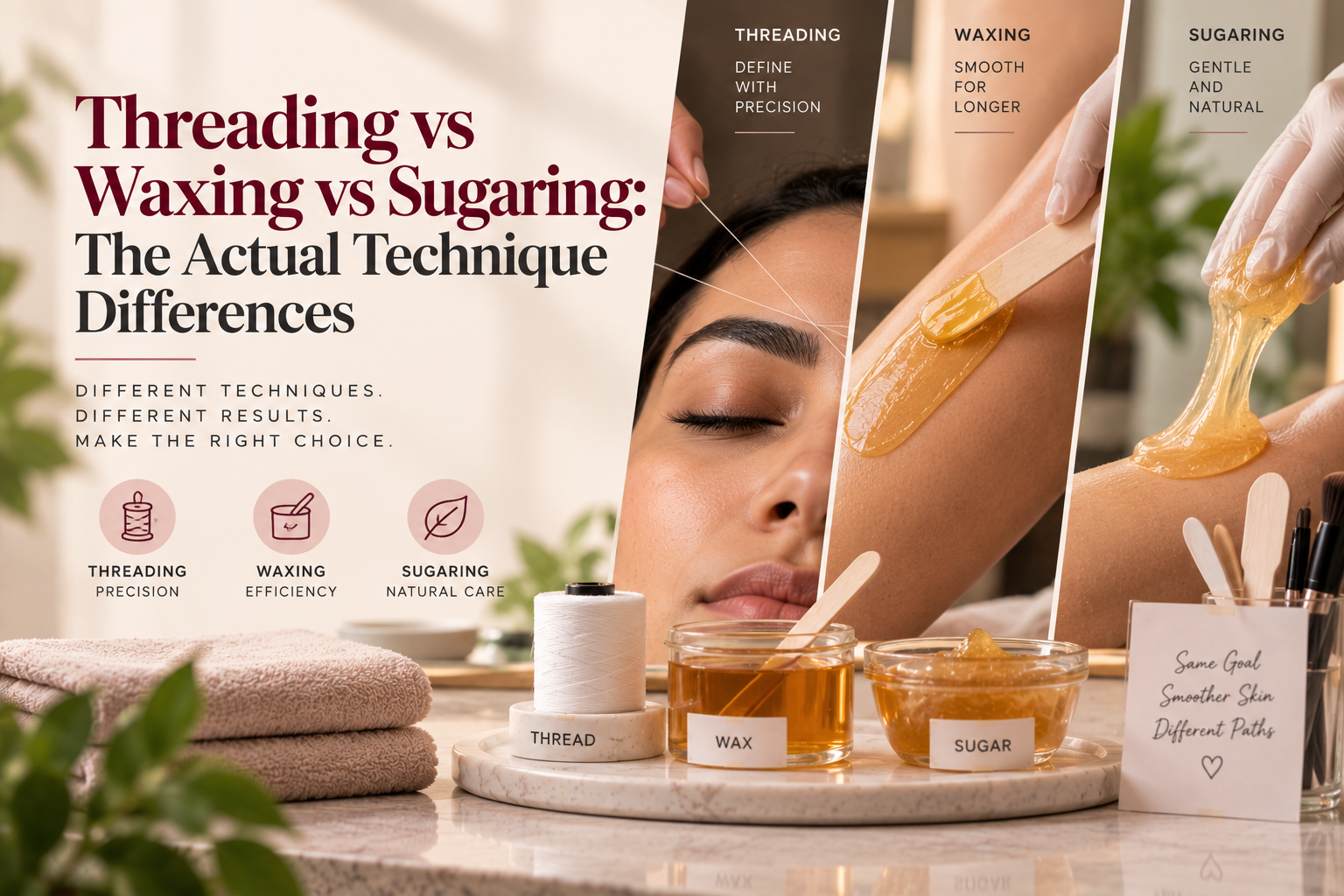
These three methods all remove hair from the root. And that surface similarity is exactly why they get treated as interchangeable. However, they’re not. Each one grips hair through a completely different mechanism, interacts with skin differently, and suits a different area or skin type. Knowing which one to recommend, and why, is a genuine technical judgement call, not a matter of personal preference or whatever the salon happens to offer. So, let’s understand the what threading, waxing, and sugaring really is.
Threading: Mechanical Removal, No Product at All
Threading uses twisted cotton thread rolled along the skin to catch and pull hair. Nothing is directly applied to the skin itself.
- The twisted thread mechanically traps hair at the follicle. It lifts it out in a clean line, rather than pulling from a wide patch at once
- No heat, wax, or chemical product ever touches the skin. It makes it a genuinely low-irritation option for reactive or sensitive skin
- Threading can catch hair as short as one to two millimetres, far shorter than waxing or sugaring require
- It’s precise but slow. It works brilliantly for eyebrow shaping and facial hair, but isn’t practical for larger areas like legs or arms
Waxing: Adhesion to Both Skin and Hair
Wax works by sticking to the hair and the surrounding skin surface at the same time. That becomes central to both its effectiveness and its risks.
- Hot wax is applied warm, hardens as it cools, and grips mainly the hair rather than bonding strongly to skin. That generally makes it gentler for sensitive areas and coarse hair
- Strip wax is spread thin and removed quickly with a cloth strip. It covers larger areas faster, but it adheres more directly to the skin’s surface
- Because wax grips the top layer of skin as well as the hair, it also lifts away dead skin cells as a side effect. That is a mild exfoliation benefit. But, it is also the reason waxing can cause more irritation or skin lifting on already fragile skin
- Hair generally needs to be at least a quarter inch long for wax to grip properly. Additionally, remember that wax is pulled against the direction of hair growth
Sugaring: Adhesion to Hair Only, Pulled With Growth
Sugaring paste, made from sugar, lemon, and water, works on a genuinely different principle than wax, even though the end result looks similar.
- The paste is water-soluble and bonds mainly to the hair itself, rather than gripping the living skin cells the way wax resin does
- It’s applied at body temperature, not heated, which removes the burn risk that comes with hot wax
- Critically, sugaring paste is applied against the direction of hair growth, then flicked off in the same direction the hair naturally grows, the reverse of how wax is removed
- This growth-direction technique matters more than it sounds. Removing hair in its natural growth direction causes less breakage at the follicle and is widely considered to reduce ingrown hairs over repeated sessions, compared to pulling against growth
Why the Growth-Direction Difference Actually Matters
This is the detail most people never get explained properly. Pulling hair against its natural growth direction, as waxing does, puts more mechanical stress on the follicle and the surrounding skin. Pulling with the growth direction, as sugaring does, works with the hair’s natural exit angle instead of against it. Over many repeated sessions, this difference shows up as fewer ingrown hairs and less follicle irritation with sugaring, which is one of the main reasons it’s often recommended for clients who struggle specifically with ingrown hairs on wax.
Matching the Method to the Client, Not Just the Area
- Sensitive, thin, or retinoid-treated skin generally tolerates threading or sugaring better than waxing, since both involve less direct adhesion to the skin’s surface
- Eyebrows and fine facial detailing are threading’s strength, precision beats speed here
- Large areas like legs or arms are usually best suited to strip waxing, purely for speed and coverage
- Coarse, dense hair often responds well to hot wax specifically, since it grips thicker hair effectively without needing repeated passes
- Clients with a history of ingrown hairs are often better served by sugaring, given the growth-direction advantage
At LTA School of Beauty, students learn the science behind these three hair removal techniques and how to apply them. Through understanding how threading, waxing, and sugaring each interact differently with hair and skin, they are able to confidently recommend and perform the method that actually suits a client’s skin and hair type.
Frequently Asked Questions
Which hurts less: waxing, threading, or sugaring?
Pain tolerance varies by person, but sugaring and threading are generally reported as gentler than waxing, since they involve less direct adhesion to the skin’s surface than wax does.
Why does sugaring reduce ingrown hairs more than waxing?
Sugaring paste is applied and removed in the direction of natural hair growth, unlike wax, which is pulled against it. This causes less follicle stress and breakage, which lowers the chance of ingrown hairs over time.
Can threading remove hair from areas other than eyebrows?
Yes, threading works well on any fine facial hair, like the upper lip or chin, but it’s too slow and impractical for larger body areas like legs or arms.
Is sugaring actually better for sensitive skin than waxing?
Generally yes. Sugaring paste bonds mainly to the hair rather than the skin’s surface, and it’s applied at body temperature, which reduces both irritation and burn risk compared to hot wax.