
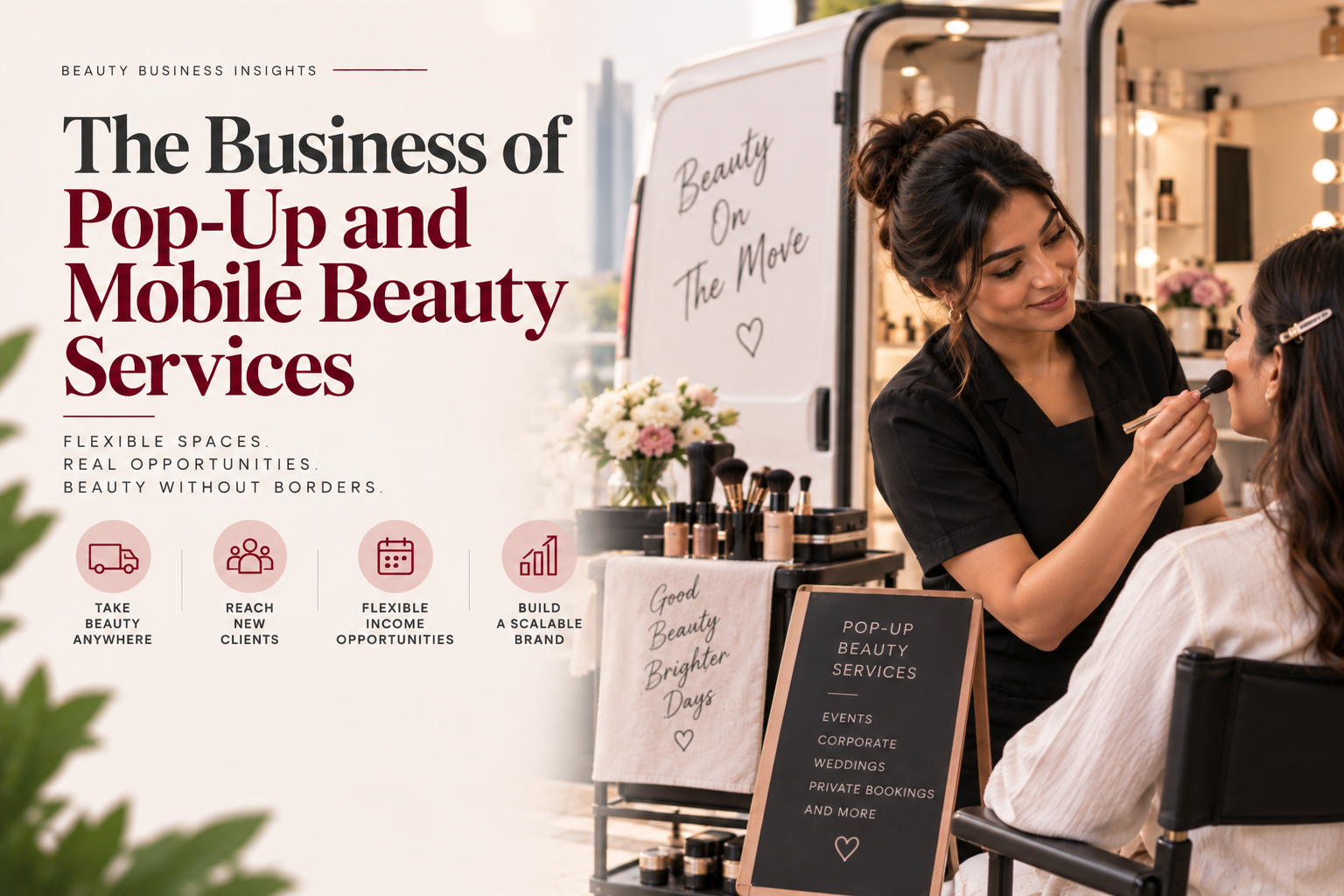
A salon used to mean a fixed address with a signboard outside. That’s changed. Pop-up beauty counters at weddings, festivals, and corporate events, along with mobile beauty vans that drive straight to a client’s doorstep, have turned “going to the salon” into an outdated assumption for a growing number of clients. This shift towards pop-Up and mobile beauty services isn’t just about convenience. It’s reshaping how beauty professionals think about overhead, client acquisition, and what a beauty business actually needs to look like to work.
What Pop-Up and Mobile Beauty Actually Look Like
These two models get lumped together often, but they’re not quite the same thing.
- Pop-up beauty services: Sets up temporarily at a specific event or location. It could be a bridal fair, a corporate wellness day, a festival, or even a mall kiosk during a busy season.
- Mobile beauty services: Travels directly to the client, usually for home appointments, bridal prep at a venue, or office-based services for corporate clients.
- Hybrid models: They are increasingly common too. Here a professional runs a small fixed studio but also offers mobile add-ons for specific occasions like weddings or events.
Both models share one core idea: the beauty service goes to where demand already exists, instead of waiting for clients to come to a fixed location.
Why This Model Is Growing
1. Lower startup costs than a traditional salon
Rent, interior setup, and long-term lease commitments are some of the biggest barriers to starting a beauty business. Mobile and pop-up models sidestep most of that, letting professionals start with just a well-stocked kit and transport.
2. Clients increasingly want convenience over ambience
They are common for a lot of services like brow tinting, basic facials, hair styling for an event. Clients are often more interested in getting it done well and quickly than in the salon experience itself.
3. Event-based demand is predictable and high-value
Weddings, corporate events, and festivals create concentrated, high-paying demand in short windows. A single wedding booking can be worth significantly more than several regular salon appointments combined.
4. Social media makes mobile services easy to market
A stylist or makeup artist can show their work directly through reels and posts, book clients through direct messages, and build a mobile-first business without ever needing a physical storefront to establish credibility.
The Real Operational Challenges With Pop-Up and Mobile Beauty Services
This model looks appealing, but it comes with a different set of problems than running a fixed salon, and these are worth understanding honestly.
- Equipment and hygiene control get harder. Sterilising tools, managing product storage temperature, and maintaining hygiene standards is far more demanding on the move than in a controlled salon environment.
- Scheduling and travel time eat into profit. Travel between appointments isn’t billable time, and underestimating it is one of the most common reasons mobile beauty businesses underprice themselves.
- Lighting and space vary wildly. A client’s home or an event venue rarely has the lighting or setup quality of a professional salon, which affects how certain services, especially makeup, need to be approached.
- Liability and insurance become more complex. Working in someone’s home or at a third-party venue introduces risks a fixed salon doesn’t usually have to think about as much.
- Inconsistent demand across seasons. Wedding and event-based income is often seasonal, so income can swing sharply between busy and slow months.
None of these challenges are reasons to avoid the model. They’re reasons to plan for it properly instead of assuming it’s simply a scaled-down salon.
How to Actually Build a Sustainable Pop-Up or Mobile Beauty Business
Price in travel time, not just service time: A facial that takes 45 minutes in a salon might realistically cost two hours once you also consider travel. Pricing needs to reflect that honestly.
Build a tight, portable toolkit, not a shrunken version of a full salon: Mobile professionals who succeed usually specialise in a smaller, well-chosen set of services they can deliver consistently well on the move, rather than trying to offer everything.
Treat hygiene protocols as non-negotiable, not optional: Disposable tools where possible, proper sanitisation routines for reusable equipment, and clear storage practices for products matter even more outside a controlled salon setting.
Diversify between event-based and regular home-service clients: Relying only on wedding season creates feast-or-famine income. Mixing in regular home facials or grooming appointments smooths out the slower months.
Use bookings data to plan travel zones: Professionals who map out which areas or venues bring in the most consistent bookings can reduce wasted travel time and plan routes more efficiently.
Why Skin and Hair Knowledge Matters Even More Without a Salon Backup
In a salon, there’s usually a senior colleague, a stocked back room, or additional equipment to fall back on if something unexpected comes up — a reaction, an unfamiliar skin concern, a product that doesn’t behave as expected. On a mobile job or at a pop-up counter, that safety net disappears. A professional is working alone, often under time pressure, with only what’s in their kit.
This makes real technical knowledge the actual foundation of a mobile beauty business, far more than it might seem at first. Knowing how to read a client’s skin quickly, understanding which products are safe to combine or avoid, and recognising early signs of a reaction all matter more when there’s no one else to consult on the spot.
FAQs
Is mobile beauty service cheaper to start than opening a salon?
Yes, generally. Mobile and pop-up models avoid rent, interior setup, and long-term lease costs, requiring mainly a well-equipped kit and reliable transport to get started.
How should mobile beauty professionals price for travel time?
Travel time should be factored directly into service pricing or charged as a separate fee, since it isn’t billable the way in-salon service time is, and ignoring it often leads to underpricing.
What hygiene precautions matter most for mobile beauty services?
Using disposable tools where possible, following strict sanitisation routines for reusable equipment, and storing products correctly outside a controlled salon environment are especially important.
Can a mobile or pop-up beauty business succeed without a physical salon at all?
Yes, especially with strong social media presence and a reliable client base, though many professionals eventually combine mobile services with a small fixed studio as the business grows.