
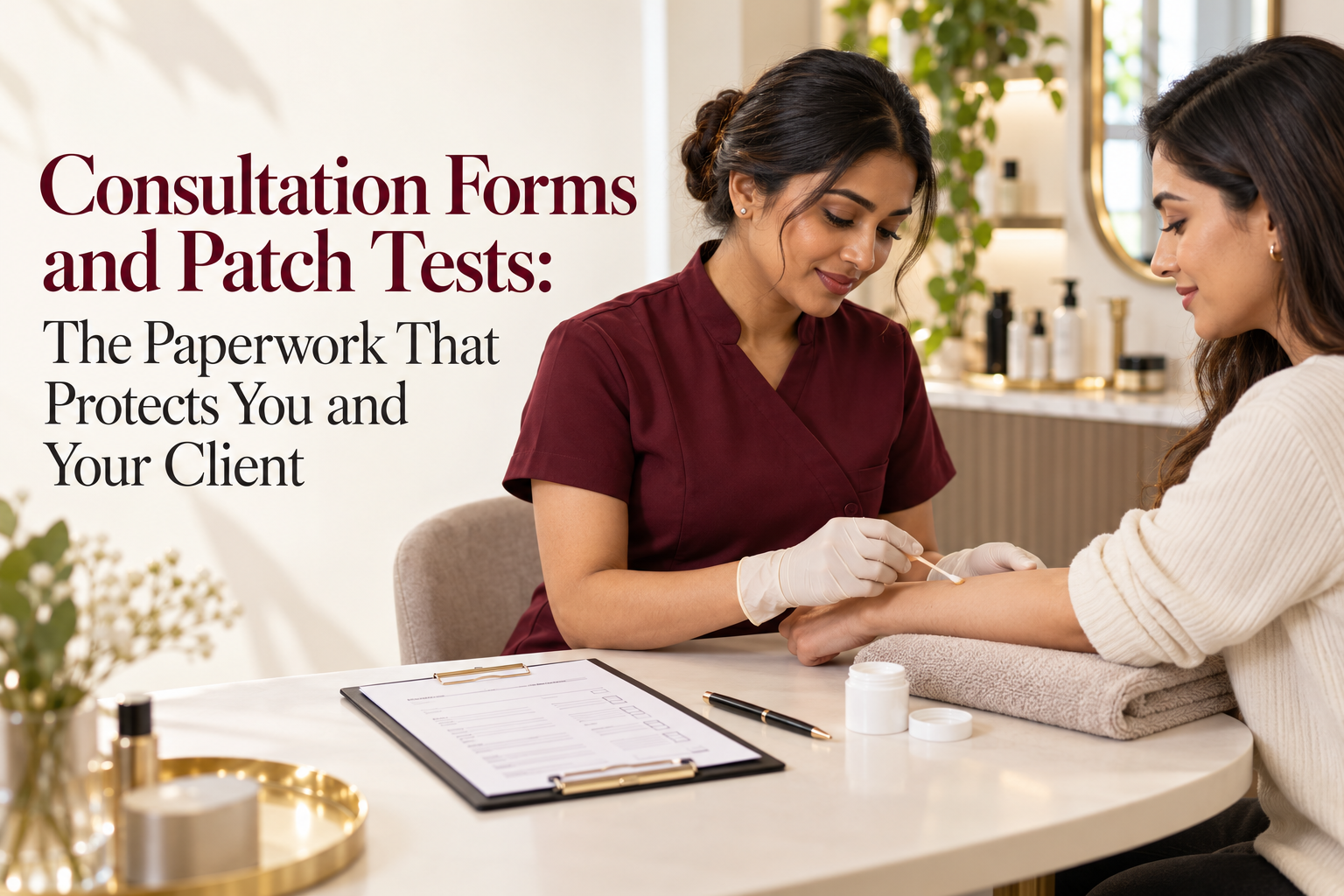
Nobody enters the beauty industry for the paperwork. It feels slow, and clients in a hurry find it annoying. But a client who has a bad reaction to hair dye or a wax burn will not remember how nice the salon looked. They will ask what you knew, what you asked and what you did. So why do consultation forms and patch tests matter? A consultation form helps you spot risks before a service begins, and a patch test checks for a reaction to a product on a small area of skin first. Together they make treatments safer for the client, and they show you acted responsibly.
What A Consultation Form Does
A consultation form is a short record of what you asked the client and what they told you. It serves three purposes:
- Safety. It helps you spot conditions, medicines, allergies or recent treatments that change what you should do.
- Planning. It tells you what the client wants, so you can choose the right service and products.
- Proof. It records that you asked the right questions and gave the right information.
It does not replace your judgment. It supports it.
What To Include In A Good Consultation Form
Keep it clear and easy to fill in. Most forms should cover:
Basic details
- Name, phone number and email
- Age or date of birth (important for minors, who need a guardian’s consent)
- Date of the visit
Health and skin information
- Known allergies, such as to hair dye, latex, fragrance, nuts or adhesives
- Skin conditions, such as eczema, psoriasis, acne or sensitive skin
- Current medicines or skin treatments, including prescription creams
- Pregnancy or breastfeeding, where relevant to the service
- Recent surgery, injections or skin procedures
- Recent sun exposure or sunburn
Service history
- Previous reactions to beauty products or treatments
- Recent chemical services, like colour, straightening or peels
- Hair or skin goals and any concerns
Consent and agreement
- A statement that the client has given true information
- Agreement to the proposed service
- Aftercare advice given
- Client signature and date, plus yours
Ask about health matters only as far as needed for the service. Do not collect more personal information than necessary.
When To Do A Patch Test
A patch test applies a small amount of a product to the skin to see whether it causes a reaction. It is most important for products that carry a higher risk of allergy, such as:
- Permanent and semi-permanent hair colour, especially dark shades containing PPD
- Eyelash and brow tints
- Eyelash extension glue
- Some chemical peels and skin treatments
- Henna products and some skin lightening treatments
- Any product the client has reacted to before
Many manufacturers recommend a patch test before the first use, and some suggest repeating it at set intervals, because a person can develop an allergy over time. Always follow the instructions of the specific product and your training.
How To Do A Patch Test
The exact method depends on the product, so use the manufacturer’s guidance. A common approach for hair colour looks like this:
- Clean the skin on the chosen area. Behind the ear or the inner elbow is common.
- Apply a small amount of the product as directed.
- Leave it uncovered and dry if the instructions say so.
- Tell the client not to wash the area and to avoid scratching it.
- Wait for the stated time. For many hair colour products this is around 48 hours.
- Check the result. If there is any redness, itching, swelling, burning or blistering, the test is positive, and the client should not have the service.
- Record the date, product, area tested and result.
Explain to the client what to look for and what to do if a reaction begins. Tell them to wash off the product and seek medical help if the reaction is strong. If they have any difficulty breathing, swelling of the face or throat, or feel faint, this is an emergency.
A Negative Result Is Not A Guarantee
A patch test lowers the risk, but it cannot remove it. A client can pass the test and still react later, especially if their skin changes or the product contains different ingredients. Do not tell clients they are “completely safe.” Tell them the test showed no reaction at that time, and ask them to contact you if they notice anything.
When To Say No Or Refer
Sometimes the right answer is to stop. Do not go ahead with a service if the client has:
- A positive patch test
- Broken, inflamed, infected or sunburnt skin in the treatment area
- A skin condition flare-up in the area
- A recent skin procedure that has not healed
- Symptoms you cannot explain
Suggest the client see a doctor or dermatologist before returning. Refusing a service politely protects the client and you.
Handling Consent Properly
Consent means the client understands what will happen and agrees to it. To make it meaningful:
- Explain the service in plain words, including what it feels like and any known risks.
- Give honest information about results. Do not promise outcomes you can’t guarantee.
- Let clients ask questions and take their time.
- Get consent in writing for higher-risk services, such as chemical treatments, lash services or any skin procedure.
- Ask permission before taking photos, and explain where they will be used. If you want to share before-and-after pictures online, get specific written permission.
- Get a parent or guardian’s consent for anyone under 18.
Keep Records The Right Way
A good record is simple, dated and easy to find.
- Store forms safely. Keep paper forms in a locked drawer, and use password protection for digital files.
- Update the form at each visit. Ask whether anything has changed since last time, and note the answer.
- Record what you did: products used, shades, timings, strengths and any issues.
- Do not share client information with anyone who does not need it.
- Keep records for as long as your employer, insurer or local rules suggest.
India’s data protection law, the Digital Personal Data Protection Act, 2023, sets rules for handling personal data. If you run a salon or studio, check how it applies to your client records.
Common Mistakes To Avoid
- Skipping the form for regular clients. Health, medicines and skin can change.
- Doing a patch test but not recording it
- Starting a service before the test time has passed
- Using a form that is too long, which clients rush through without reading
- Promising that a patch test makes the service “100% safe”
- Using the same patch test result for different products
A Quick Checklist
| Before | During | After |
| Form filled and signed | Products match the patch test | Aftercare advice given |
| Patch test done and clear (if needed) | Consent confirmed | Record updated |
| Contraindications checked | Client comfortable and informed | Follow-up contact noted |
At LTA School of Beauty, students learn that safe practice begins before the first product touches the skin. By practising consultations, patch tests and record keeping during training, they are able to work with confidence and protect both their clients and their own professional reputation.
FAQs
What should a salon consultation form include?
A good form includes contact details, allergies, skin conditions, medicines, recent treatments, previous reactions, the client’s goals, consent and a signature with the date. Keep it clear and only ask for information that is relevant to the service.
When is a patch test needed?
A patch test is advised before services that carry a higher chance of allergic reaction, such as hair colour, eyelash and brow tints, lash extension adhesive and some skin treatments. Follow the product instructions on when to test and how often to repeat it.
How long should I wait after a patch test?
It depends on the product. For many hair colour products, the instructions say to wait around 48 hours before the service. Always follow the manufacturer’s guidance and your training.
Can a client still have a reaction after a negative patch test?
Yes. A patch test lowers the risk but does not remove it. Skin can change, and reactions can develop over time. Tell clients to contact you if they notice itching, redness or swelling, and seek medical help if a reaction is severe.