
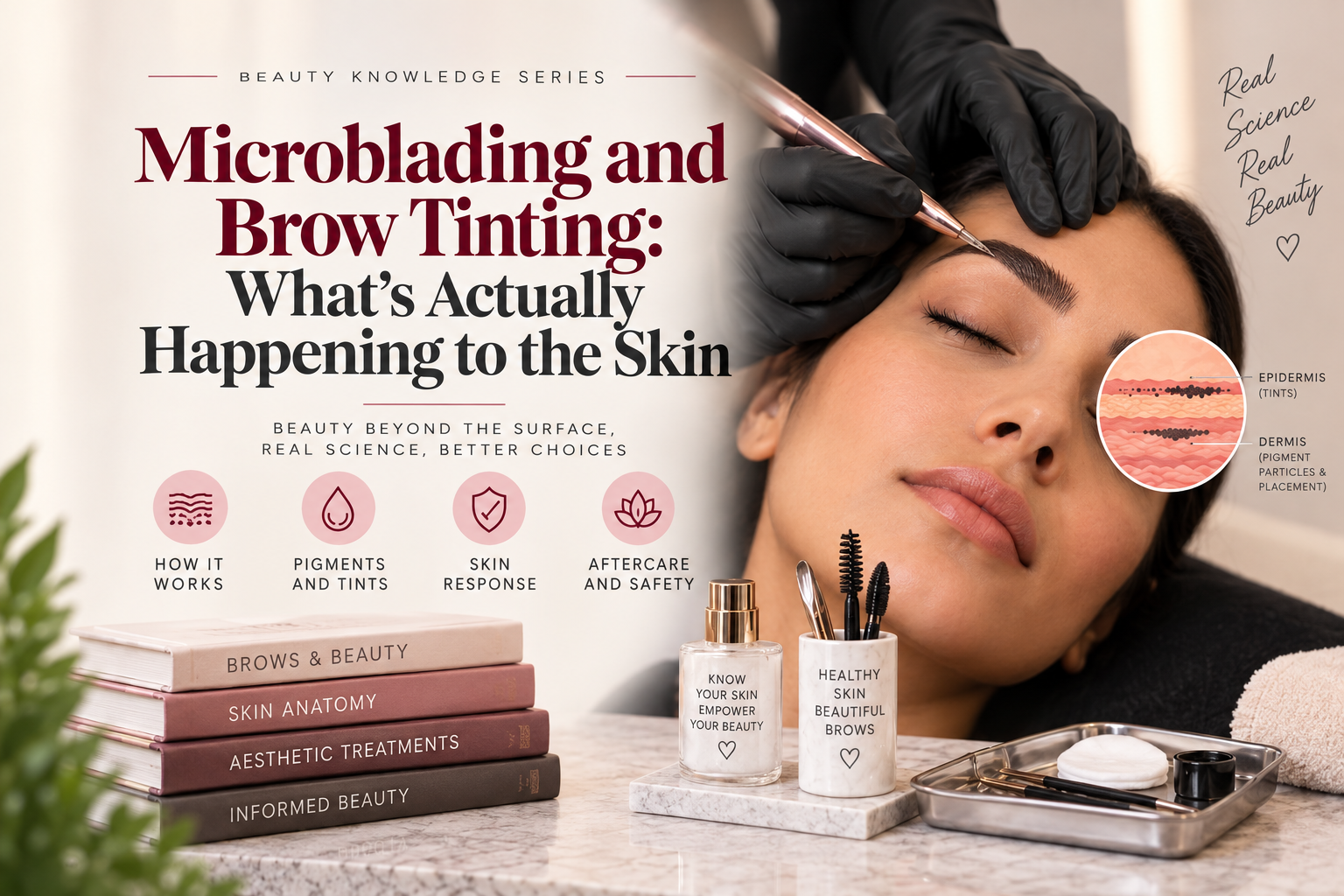
Eyebrows have quietly become one of the most fussed-over parts of the face. Microblading and brow tinting are now everyday salon requests, not niche treatments. But most clients walking in for either service have almost no idea what’s actually happening to their skin during the process. And honestly, a lot of professionals could explain it better too. Understanding the real skin mechanics behind microblading and brow tinting isn’t just useful trivia. It’s what separates a professional who can handle complications and answer questions confidently from one who’s just following a routine.
Microblading: What’s Really Going On Under the Skin
Microblading looks simple from the outside, like fine, hair-like strokes that mimic natural brow hairs. But it’s a form of semi-permanent tattooing, and understanding that changes how it should be approached.
It’s a controlled wound, not just pigment application
A microblading tool uses a row of tiny needles to create shallow cuts in the skin’s upper layer, called the epidermis, sometimes reaching the very top of the dermis. Pigment is deposited into these cuts. This means microblading is technically a wound-healing process, not a surface treatment.
The skin’s healing response determines the final result
Once the strokes are made, the body treats it like any minor injury:
- Inflammation phase: The skin reddens and may feel tender for a few days as blood flow increases to the area.
- Healing and scabbing phase: Light scabbing or flaking usually appears around days 4 to 7, which is completely normal and shouldn’t be picked at.
- Pigment settling phase: Over the next few weeks, some pigment naturally fades as the skin heals, which is why touch-up sessions are almost always necessary.
Skin type changes everything
This is where a lot of amateur work goes wrong. Oily skin, for example, tends to blur microbladed strokes over time because higher oil production pushes pigment to spread slightly under the skin, making sharp hair-like lines soften into a more powdery look within months. Drier or more mature skin tends to hold defined strokes longer, but may also show more visible healing texture initially.
A professional who understands this can set accurate expectations before the procedure even starts, instead of clients being surprised months later.
Brow Tinting: A Completely Different Process
Unlike microblading, brow tinting doesn’t break the skin at all. It’s a surface-level treatment, but it still involves real chemistry that’s worth understanding.
It works through oxidation, not just “dye”
Most brow tints use oxidative dye, meaning the tint is mixed with a developer that triggers a chemical reaction. This reaction is what allows the pigment to actually bond to the hair shaft rather than just sitting on top of it temporarily.
Skin sensitivity is the real risk factor
Because tint sits directly on the skin around the brow area during processing, allergic reactions are the main concern, not damage to the skin itself. This is exactly why patch testing 24 to 48 hours before the actual appointment isn’t just a formality. It’s a genuine safety step that identifies sensitivity before it becomes a reaction on someone’s face.
Porosity affects how long it lasts
Just like hair on the scalp, eyebrow hair has a porosity level. Porosity means how easily it absorbs and holds pigment. Coarser or previously over-plucked brow hair often holds tint longer, while fine, sparse brow hair may need more frequent touch-ups.
Where Microblading and Brow Tinting Actually Overlap
Clients often ask whether they should get one or the other, or occasionally both. The honest answer depends entirely on what’s happening with their skin and brow hair already.
- Sparse or patchy brows: They tend to benefit more from microblading, since tinting alone can’t fill in visible gaps.
- Naturally full brows that just need definition: They are often better suited to tinting alone, since it’s less invasive and requires no healing period.
- Combination approaches: These are increasingly common. Tinting is used to unify colour, alongside microblading to define shape. But this needs to be sequenced carefully, since doing both too close together can irritate healing skin.
Getting this recommendation right requires actually understanding skin condition, hair growth pattern, and healing capacity. It’s not just about picking whichever service a client asks for first.
Why Aftercare Knowledge Matters As Much As the Procedure
A lot of complications with both treatments don’t come from the procedure itself. They come from poor aftercare, often because clients were never properly told what to do.
- After microblading: Avoid water directly on the brows for the first several days. No makeup on the area until fully healed. And absolutely no picking at scabbing, since this can pull pigment out unevenly.
- After tinting: Avoid oil-based cleansers immediately after, since oil can strip tint faster, and avoid rubbing the brow area for the first 24 hours.
A professional who explains this clearly, and explains why, gets far better results and far fewer complaints than one who just hands over a printed aftercare sheet.
Why This Comes Down to Actual Skin Science
Both treatments look simple in a five-minute video, but underneath them is real biology. It involves wound healing, oxidative chemistry, skin oil production, hair porosity. A professional who understands these mechanics can recognise when a client’s skin type calls for a different approach, spot early signs of a reaction, and set expectations that actually hold up over the following weeks.
FAQs
Is microblading painful, and does it damage the skin permanently?
Most clients feel mild discomfort rather than sharp pain, since numbing cream is applied beforehand. The cuts are shallow and heal within the epidermis, so there’s no permanent skin damage when done correctly.
Why do brow tint results fade faster on some people than others?
Fading speed depends largely on hair porosity and how often the brow area is exposed to oil-based products, sun, or frequent washing, all of which can break down tint faster.
How long should someone wait between brow tinting and microblading?
It’s generally recommended to space these treatments a few weeks apart, allowing skin from either procedure to fully settle before introducing another treatment to the same area.
Is a patch test really necessary before brow tinting?
Yes. Since tint involves an oxidative chemical reaction on skin, a patch test 24 to 48 hours beforehand is the only reliable way to catch a potential allergic reaction before it affects the full brow area.