
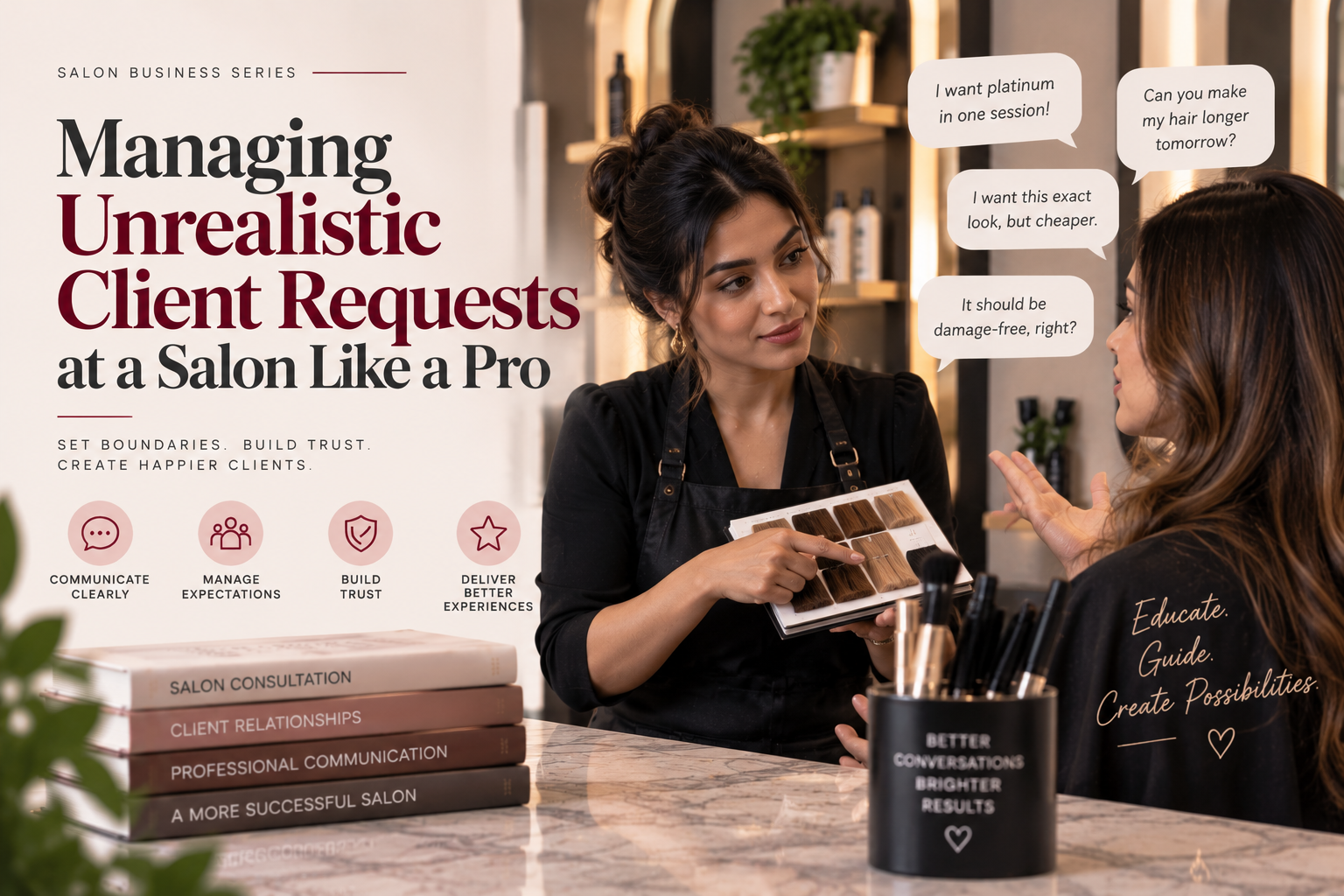
Every salon professional has been there. A client walks in with a photo of a celebrity and says, “I want this exact colour, this exact cut, by tomorrow.” The hair in the photo is professionally styled, filtered, and probably not even the client’s actual hair texture. But somehow, the expectation is that it should look identical on them, in one sitting, without any damage. Handling such moments and managing unrealistic client requests well isn’t just about being polite. It’s a skill. And like any skill, it can be learned, practised, and mastered.
Why Clients Ask for the Impossible
Most unrealistic requests don’t come from clients trying to be difficult. They come from a gap in information. Social media has made everyone a hairstylist and skincare expert overnight. Except most of what people see online skips the technical part entirely.
A few common reasons clients walk in with expectations that don’t match reality:
- They don’t understand hair or skin science. Someone with fine, previously coloured hair doesn’t know that going three shades lighter in one session could mean serious breakage.
- They’ve seen a filtered or edited result. Instagram and Pinterest photos are often retouched, professionally lit, or shot with extensions and wigs.
- They’re comparing their hair or skin to someone else’s. Genetics, previous chemical treatments, and even the season can change what’s realistically achievable.
- They don’t know the timeline involved. Some transformations, especially colour corrections, need multiple sessions spaced weeks apart, not one long appointment.
Understanding this is the first step. A client asking for something impossible usually isn’t testing you. They just don’t have the technical knowledge you do.
The Real Cost of Saying Yes While Managing Unrealistic Client Requests
It’s tempting to just agree, especially with a client who seems upset or insistent. But saying yes to a request that isn’t realistic almost always backfires.
Think about what actually happens when a stylist pushes through a request they know is risky:
- The hair or skin reacts badly, like breakage, over-processing, irritation, uneven results.
- The client is unhappy with the outcome anyway, because it still didn’t match the photo.
- Trust breaks down, and that client is unlikely to come back, or worse, leaves a negative review.
- The professional’s own confidence and reputation take a hit.
Saying no to the wrong request, done well, protects both the client and the business. It’s not about refusing to help. It’s about refusing to cause harm in the name of pleasing someone in the moment.
How to Say No Without Losing the Client
The goal isn’t to shut a request down. It’s to redirect it toward something that actually works. Here’s how experienced professionals do it.
1. Explain the “why,” not just the “no”
Clients respond better to reasoning than to refusal. Instead of “I can’t do that,” try something like: “Your hair has had two previous colour treatments, so going this light in one sitting would likely cause breakage. Here’s what I’d recommend instead.”
This shifts the conversation from a rejection to a consultation. And it builds the kind of confidence that makes clients trust your judgement long-term.
2. Offer a realistic alternative, every time
A no without an alternative feels like a dead end. A no with a plan feels like expertise. If someone wants platinum blonde in one session, offer a roadmap: “We can get you noticeably lighter today, then do a follow-up session in four weeks to reach the full tone safely.”
3. Use visuals and education, not just words
Sometimes clients don’t believe a request is unrealistic until they see why. Swatch tests, patch tests, or even simple diagrams of hair structure can do more convincing than a verbal explanation ever will.
4. Set expectations before the service starts, not during
A lot of tension during a service comes from expectations that were never clearly set at the start. A short, honest pre-service conversation should be about what’s possible, what’s not, and why. It saves everyone frustration later.
5. Stay calm, even if the client pushes back
Some clients will insist. Staying calm, professional, and consistent in your reasoning (without getting defensive) is usually what turns the moment around. Most people respect a professional who clearly knows what they’re doing, even when the answer is “not today.”
Where Skin and Hair Science Actually Comes In
This entire skill revolves around reading a request, understanding why it might not work, and offering a safer alternative. It rests on one thing: actually knowing the science behind what you’re doing.
A stylist or skincare professional who understands how hair structure responds to bleach, or how active ingredients interact with different skin types, isn’t guessing when they say no. They’re making an informed, evidence-based call. That’s the difference between a professional opinion and a personal preference, and clients can usually tell which one they’re getting.
This is also why proper training matters so much in this industry. Knowing the theory behind a treatment doesn’t just improve results. It gives professionals the language and confidence to have these tricky conversations without feeling like they’re disappointing someone.
Managing Unrealistic Client Requests and Building Trust
Here’s the part that often gets missed: handled well, an unrealistic request can actually become the moment a client trusts you the most. When someone sees that you cared enough about their hair or skin to tell them the truth instead of just taking their money, that builds a different kind of relationship. It’s not transactional anymore. It’s the beginning of someone becoming a regular.
Professionals who consistently manage these conversations with honesty and skill tend to build stronger, longer client relationships than those who simply agree to everything. Reputation in this industry is built request by request, conversation by conversation.
FAQs
Q: How do I tell a client their hair goals aren’t achievable without upsetting them?
Lead with the reasoning, not the refusal. Explain what the hair or skin can currently handle, then offer a realistic alternative or a phased plan to get there safely.
Q: Why do clients often expect results they’ve seen on social media?
Most social media photos are edited, filtered, or shot under ideal lighting and conditions. Clients often aren’t aware of this, so a quick, respectful explanation usually helps reset expectations.
Q: Should I ever agree to a risky request just to keep a client happy?
No. A damaged result almost always costs more trust than a well-explained no. Long-term client relationships are built on honesty, not on saying yes to everything.
Q: What’s the best way to prevent these conflicts before they start?
A short consultation before every service, where expectations, limitations, and timelines are discussed openly, prevents most misunderstandings before they happen.