
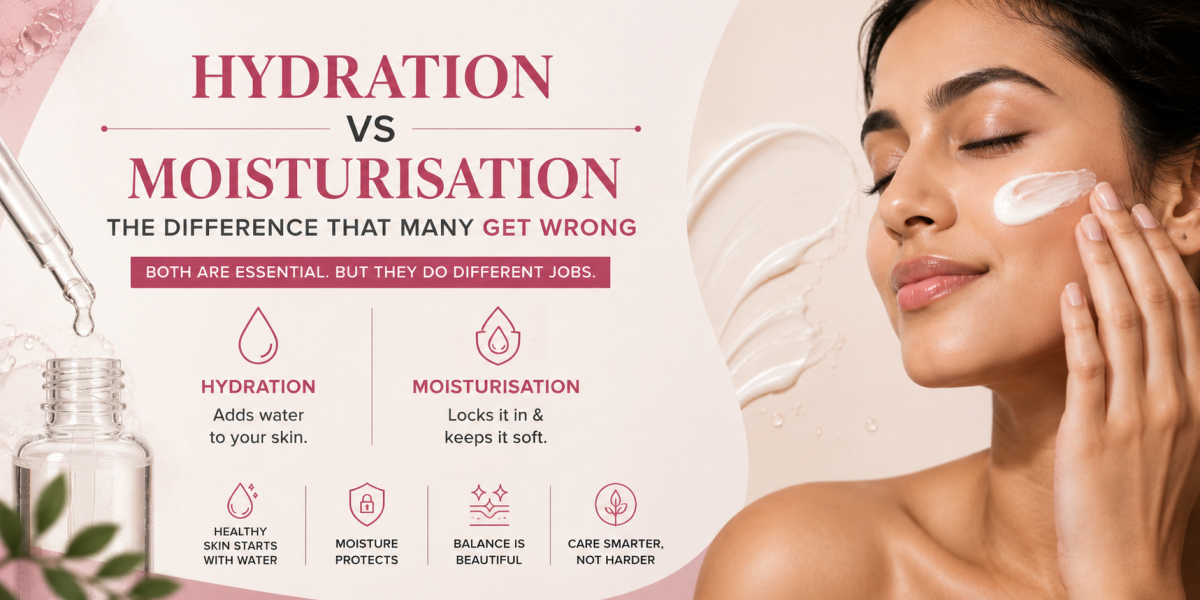
Ask different clients what ‘hydrated skin’ means and you’ll get many different answers. Ask beauty professionals the same question, and still, several of them might give the wrong answers. The distinction between hydration vs moisturisation is still a confusion.
We’ve all had clients who swear by hyaluronic acid serum, feeling convinced that it’ll their dry and dehydrated skin in just a few weeks. And professionals have to ultimately explain them that hydration and moisturisation aren’t the same thing. While one brings water in, the other keeps it there. These are two different jobs. It requires two different ingredient categories.
So, let’s actually break hydration vs moisturisation down, in a way any client or professional will easily understand it.
Hydration is about water content in the skin. Moisturisation is about locking that water in so it doesn’t evaporate quickly. Skin that’s ‘hydrated’ but not ‘moisturised’ is like watering a plant in cracked, sun-baked soil. The water goes into the soil, but it doesn’t stay.
That’s where three ingredient families come in: humectants, emollients, occlusives. None of them work alone. All of them are doing a different job on your client’s skin, whether your client knows it or not.
Humectants: The Water Magnets
Glycerin, hyaluronic acid, aloe vera, panthenol, these are all humectants. A humectant pull moisture into the skin’s outer layers. This is exactly why they are famous amongst glass skin enthusiasts. But here’s the important point: humectants without backup can actually make dehydrated skin worse in low-humidity conditions, because they’ll pull water from wherever’s available. That includes deeper skin layers, if there’s nothing on the surface to seal it in.
In a nutshell: Humectants are like tiny sponges that absorb water molecules and hold onto them. Hyaluronic acid alone can hold up to 1,000 times its weight in water. That’s why one drop of it feels like you’ve immersed your face in a hydrating facial.
The best way to use it: Humectant serums (hyaluronic acid, glycerin-based toners) must be applied on damp skin. Apply them right after cleansing, when there’s still moisture on the surface for them to grab onto.
In dry climates or air-conditioned rooms, always follow with an occlusive or emollient moisturiser within 60 seconds, or you’re setting yourself up for the exact dehydration you were trying to fix.
Emollients: The Repair Crew
Emollients include ingredients like ceramides, squalane, shea butter, and jojoba oil. These fit into the gaps between skin cells, smoothing rough or flaky texture and reinforcing the skin barrier. If your client’s main complaint is “my skin feels tight and rough,” emollients will do the heavy lifting.
In a nutshell: Emollients fill in the tiny gaps between skin cells, the way grout fills gaps between tiles. It prevents moisture from leaking out and makes skin feels softer almost immediately.
The best way to use it: Ceramide creams and squalane oils should be used after humectant serum and before heavier occlusive layer. They’re usually gentle for daily use and suit most skin types.
Pro tip: If you’re recovering from retinoid purging or a bad reaction to actives, lean on emollients for a few weeks before reintroducing anything stronger.
Occlusives: The Seal
Petrolatum, beeswax, lanolin, and dimethicone are all occlusives. They sit on top and slow transepidermal water loss (TEWL. It’s the process by which water quietly escapes through the skin all day. Occlusives don’t add a drop of moisture themselves. Their entire job is to stop what’s already there from leaving.
In a nutshell: They physically block water vapour from escaping, which is why petrolatum remains one of the most clinically proven barrier-repair ingredients dermatologists recommend.
The best way to use it: Always the last step in your routine. A thin layer of an occlusive-heavy night cream or balm works best at night, when TEWL peaks and there’s no makeup or SPF to worry about layering under.
Putting it All Together
If you put it together into a moisturiser, you get one product doing three jobs at once: pull water in, repair the surface, seal it shut. That’s why a well-formulated cream rarely leans on a single hero ingredient. And, also why a hyaluronic acid serum alone, however trendy, can’t fix damaged barrier or chronically dry skin.
Why This Difference is Important for Professionals
This is also where a lot of professionals lose clients’ trust without realising it. Recommending a product because it’s “trending” instead of explaining what it actually does reads as guesswork. Today’s clients do their own ingredient research before they walk in. The professionals who explain the why behind a recommendation are the ones clients keep coming back to.
At LTA School of Beauty, this is exactly the kind of foundation we build before technique, because a facial protocol only works as well as the skin science behind it.
Frequently Asked Questions
1. What’s the difference between hydration vs moisturisation?
Hydration means increasing the water content in the skin. Moisturisation means helping the skin retain that water by strengthening the barrier and reducing water loss. You need both as hydration without moisturisation just evaporates.
2. Can I use just a hyaluronic acid serum for dry skin?
Not reliably. Hyaluronic acid is a strong humectant, but if the skin barrier is compromised or the air is dry, it won’t hold onto the moisture it draws in. Pair it with an emollient or occlusive to actually see results.
3. What ingredients fall into each category?
Humectants: glycerin, hyaluronic acid, aloe vera, panthenol.
Emollients: ceramides, squalane, shea butter, jojoba oil.
Occlusives: petrolatum, beeswax, lanolin, dimethicone.
4. Why does this matter specifically for beauty professionals?
Clients read ingredient labels before they book a treatment. Being able to explain why a product works rather than saying it works is what separates a professional from a salesperson, and it’s what builds long-term client trust.