
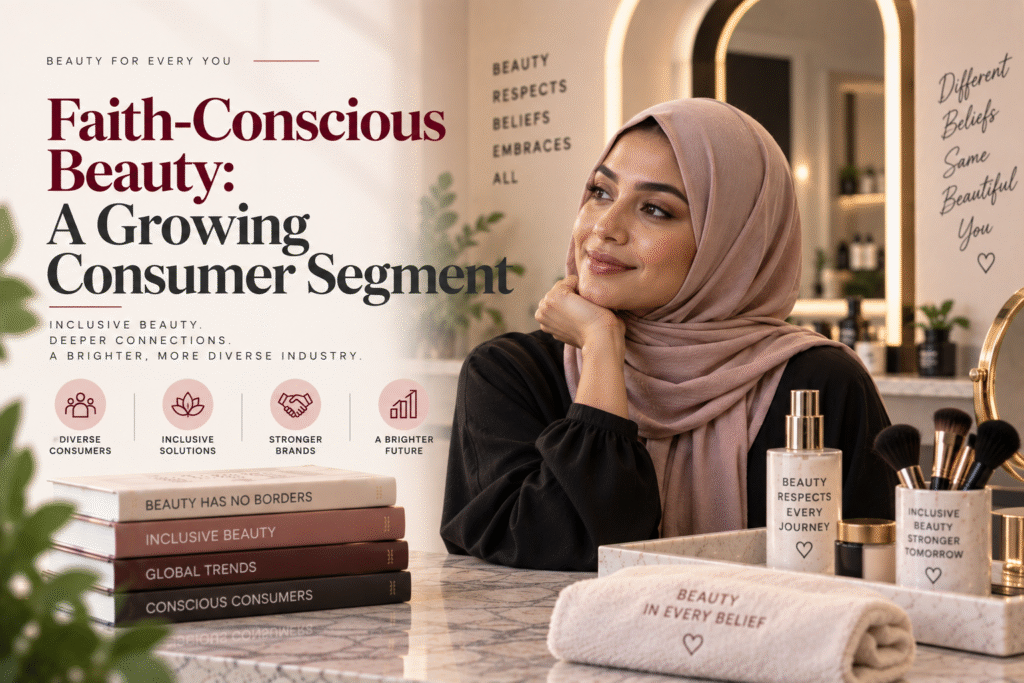
Beauty has never been one-size-fits-all. But over the last few years, something specific has been shifting in how brands and salons think about their customers: faith. Halal-certified skincare, alcohol-free fragrances, cruelty-free and vegetarian formulations for religious dietary reasons, modest beauty services designed around religious dress codes as segments are growing. This is no longer a niche request. It’s a growing, vocal, and financially significant consumer segment. For beauty professionals, understanding this shift around faith-conscious beauty isn’t about politics or personal belief. It’s about recognising a real market and knowing how to serve it competently.
What “Faith-Conscious Beauty” Actually Means
The term covers a wide range of needs, and it’s easy to oversimplify it into just one category. In reality, it includes:
- Halal-certified cosmetics and skincare: Free from alcohol, pork-derived ingredients (like certain collagens or glycerin sources), and other components considered non-permissible in Islamic dietary and lifestyle law.
- Non-violence-based beauty: It’s popular among some Jain and Hindu consumers, avoiding animal-derived ingredients and any product tested on animals.
- Kosher-certified beauty products: Follows Jewish dietary law, particularly relevant in skincare and lip products that might be ingested.
- Modesty-based service preferences: Includes clients requesting female-only staff, private treatment rooms, or services that don’t require removing religious headwear.
- Fasting-conscious scheduling: Clients, especially during periods like Ramadan or Navratri, may want lighter treatments, different appointment timings, or adjusted product recommendations.
None of these are fringe requests anymore. They’re everyday considerations for a large and growing part of the beauty-buying public.
Why Faith-Conscious Beauty Segment Is Growing
A few forces are driving this shift, and they’re worth understanding individually rather than lumping together as “trend.”
1. Rising disposable income among faith-observant consumers
Across South Asia, the Middle East, and diaspora communities worldwide, faith-observant consumers increasingly have more spending power. They’re actively looking for brands that don’t ask them to compromise their values to participate in beauty and self-care.
2. Better product literacy
Consumers today read ingredient labels. They know what glycerin sources to check, what “may contain alcohol” means on a fragrance. They ask questions salons weren’t used to fielding a decade ago.
3. Social proof and community trust
Recommendations inside religious or cultural communities carry enormous weight. A salon or brand that gets it right with one client often gains several more through word of mouth. One that gets it wrong loses that same community’s trust just as fast.
4. Global halal beauty market growth
The halal cosmetics market alone has been one of the fastest-growing segments within the broader beauty industry. It’s driven by demand across several countries and by consumers who see halal certification as a marker of cleaner, more transparent formulation.
How Salons and Brands Can Actually Serve This Segment Well
Recognising the trend is one thing. Serving it competently is another. Here’s where most salons either win or lose faith-conscious clients.
Get the ingredient knowledge right, not just the marketing.
Slapping “halal-friendly” on a product without understanding certification standards does more damage than saying nothing at all. Staff should know which ingredients typically raise questions. This cpuld be alcohol denat in toners, certain gelatin-based masks, animal-derived keratin treatments. Staff should be able to explain alternatives.
Train staff to answer questions confidently.
A client asking “is this alcohol-free?” deserves a clear, accurate answer, not a shrug. This is a service quality issue as much as it is a religious sensitivity one.
Offer real alternatives, not vague reassurance.
If a client can’t use a particular product, have a genuine substitute ready. Do not just say, “I think it should be fine.”
Respect scheduling and service preferences without making it a big deal.
Female-only appointment slots, adjusted treatment timing during fasting periods, or simply not making a client explain themselves repeatedly. These small operational choices build long-term loyalty.
Be transparent about certification
If a product isn’t halal or kosher certified, say so plainly rather than letting a client assume. Overpromising here damages trust permanently.
The Faith-Conscious Beauty Business Case, Beyond the Ethics
It’s worth being direct about this: faith-conscious beauty isn’t just a values conversation, it’s a revenue conversation. Salons and brands that build genuine competence here are tapping into:
- A large, loyal, and referral-driven customer base
- Reduced product returns and complaints from ingredient mismatches
- A meaningful point of differentiation in a crowded beauty market
- Long-term client relationships built on trust rather than one-off transactions
None of this requires overhauling an entire business model. It requires accurate product knowledge, honest communication, and staff who are trained to handle these conversations without treating them as unusual or inconvenient.
Why This Starts With Training, Not Just Product Selection
A lot of salons try to solve this at the product level. Like, stocking a few halal-certified items, adding a line to the menu. But the real gap is almost always at the staff level. A stylist or skincare professional who doesn’t understand why a client is asking about alcohol content, or why a particular ingredient matters religiously, can’t answer with the confidence that builds trust.
This is where proper skin science education becomes the foundation, not an add-on. Understanding ingredients, what they are, where they come from, how they interact with skin is what allows a professional to answer a faith-based question accurately instead of vaguely.
FAQs
Q: What does “faith-conscious beauty” actually include?
It covers halal-certified and kosher-certified products, cruelty-free formulations avoiding animal ingredients, and service preferences like female-only staff or fasting-adjusted scheduling.
Q: Is halal-certified skincare only relevant for Muslim consumers?
No. Many non-Muslim consumers now choose halal-certified products because the certification is often associated with cleaner, more transparent ingredient sourcing.
Q: How can a salon avoid mislabeling products as faith-friendly?
Staff need real ingredient knowledge and access to accurate certification information, rather than relying on assumptions or marketing language alone.
Q: Why is this segment growing so quickly?
Rising disposable income among faith-observant consumers, greater ingredient literacy, and strong community-based word of mouth are the main drivers behind this growth.