
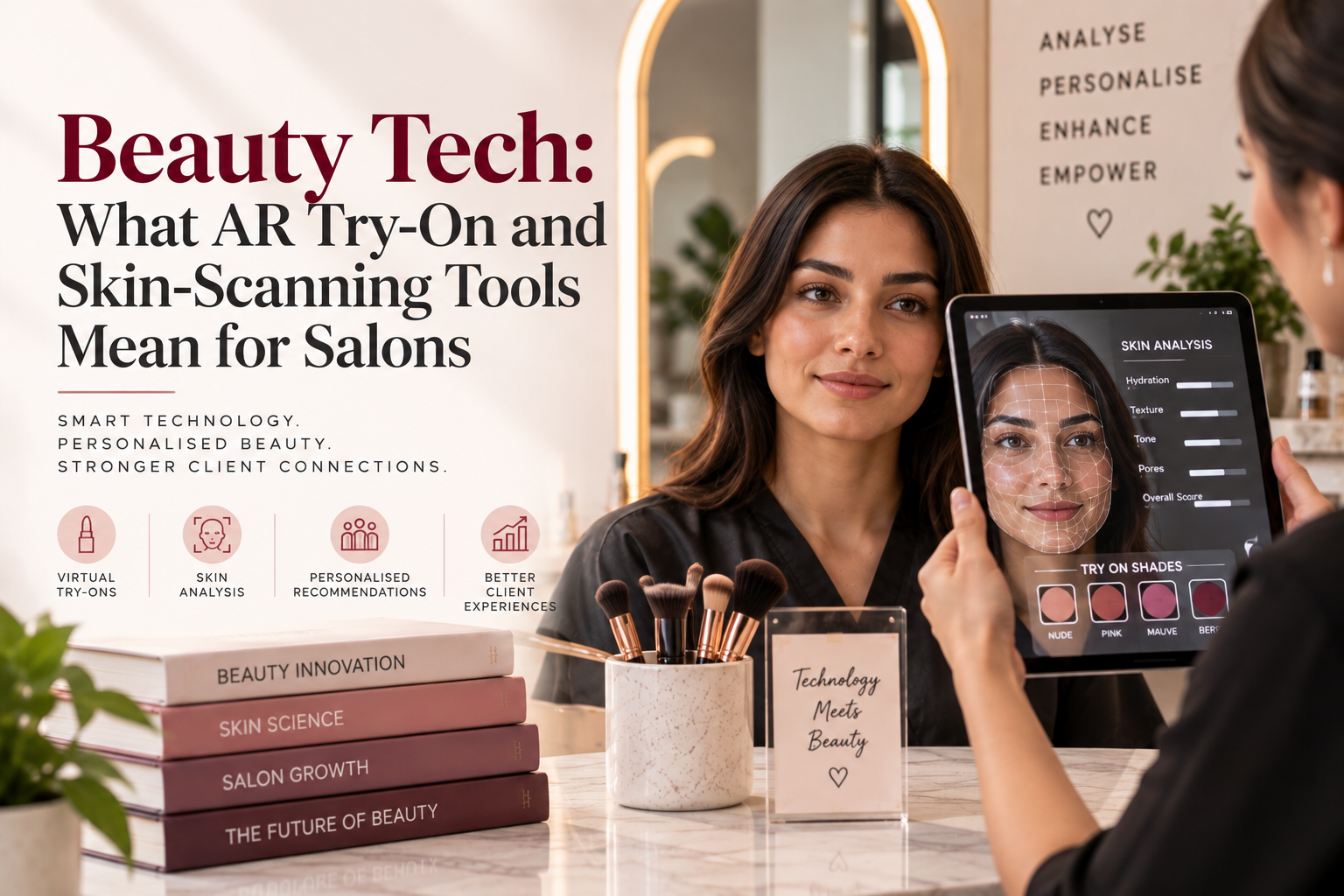
Two different technologies keep getting lumped together under “beauty tech,” and salons that don’t understand the difference end up either overselling what a tool can do or missing what it’s actually good for. AR try-on lets a client preview a look before committing to it. Skin-scanning tools measure what’s actually happening beneath the surface of the skin. Both are genuinely useful. Both also come with real limitations that a trained professional needs to understand, not just switch on and trust blindly. So, let’s understand what AR try-on and skin scanning tools actually are.
How AR Try-On Actually Works, and Where It Falls Short
AR try-on tools for makeup and hair colour work by detecting hundreds of facial landmark points through a phone or salon camera. It then renders a digital overlay of colour or product onto the live image in real time.
- The technology has genuinely improved since early versions launched over a decade ago. Shade matching in particular has become far more reliable
- Accuracy still depends heavily on lighting, camera quality, and how the underlying software handles different skin tones. Platforms have openly acknowledged that rendering accuracy still lags on deeper and less-represented skin tones compared to lighter ones
- A preview that looks flawless on screen doesn’t account for how a colour will actually interact with a client’s real hair porosity, texture, or skin’s true undertone once the product is physically applied
This creates what’s essentially an expectation gap. A client who fell in love with a filtered preview can walk in expecting an exact match to what they saw on their phone screen. The professional is the one who has to bridge that gap in person.
The Skin-Scanning Shift: From “This Feels Dry” to Actual Data
Skin-scanning devices are becoming increasingly common in premium skin clinics and salons. They use multi-spectral or UV imaging to reveal things a standard consultation under normal light simply can’t see.
- These tools can visualise sun damage, pigmentation, and pore congestion sitting below the visible surface of the skin. They can show these signs long before it shows up to the naked eye
- This turns a subjective consultation, “your skin feels a bit dry,” into a measurable, trackable data point a client can actually see and compare over time
- For retention, this is powerful. A client who can see a quantified improvement in a follow-up scan has real evidence a treatment plan is working. They are not just taking a professional’s word for it
The New Ethical Question These AR Try-On And Skin Scanning Tools Create
Objective-looking data creates a new kind of pressure that didn’t exist with a purely verbal consultation. A number on a screen can feel more convincing and less questionable than a person’s opinion. That is even when the underlying finding doesn’t actually require the treatment being recommended alongside it.
- A scan showing mild, normal pigmentation can be used honestly, to educate a client. Or, it can be used to manufacture urgency around a treatment package that wasn’t actually necessary
- The professional interpreting the scan carries the same ethical responsibility they always did. The device doesn’t remove that responsibility. It just makes the sales pitch look more scientific
- Clients are becoming more aware of this. Salons that use scan data to genuinely educate rather than pressure tend to build more durable trust than ones that lean on the data as a closing tactic
The Two-Tier Salon Problem This Technology Is Quietly Creating
Skin-scanning devices and premium AR setups aren’t cheap. That cost is creating a visible divide. Larger, well-funded salons and clinics can invest in this equipment and market it as a point of credibility. Smaller, equally skilled salons that can’t afford the hardware risk looking less trustworthy to clients, even when the actual service quality is identical or better. This is less about the technology being essential and more about how quickly it’s becoming a perceived credibility signal, whether or not that perception is entirely fair.
What This Means for a Beauty Professional’s Own Skill Set
Operating these tools well is its own skill, separate from the underlying beauty technique.
- Interpreting a skin scan correctly, and knowing when a reading is inconclusive rather than diagnostic, takes training beyond a standard beauty curriculum
- Misreading or overstating what a scan shows is a genuine professional liability. It’s not just a sales misstep, since it can lead a client toward an unnecessary or even harmful treatment
- The professionals who benefit most from this technology are the ones who treat it as a second opinion supporting their trained judgement, not a replacement for the judgement itself
At LTA School of Beauty, students learn how emerging beauty technology fits alongside trained skill, not instead of it. Through understanding what these tools actually measure and where their limits are, they are able to confidently use technology to support their judgement rather than replace it.
Frequently Asked Questions
Is AR makeup try-on actually accurate to the real result?
It’s improved significantly, but accuracy still depends on lighting, camera quality, and skin tone rendering, which platforms themselves acknowledge is less reliable on deeper skin tones. It’s a useful preview, not a guaranteed exact match.
What do skin-scanning devices in salons actually measure?
Most use multi-spectral or UV imaging to reveal sun damage, pigmentation, and pore congestion beneath the visible surface of the skin, things a standard consultation under normal light can’t detect.
Can skin-scanning tools be used to oversell treatments?
Yes, if used irresponsibly. A scan showing a normal, minor finding can be framed as urgent to push an unnecessary treatment. The device doesn’t remove the professional’s ethical responsibility in how the data is presented.
Do beauty professionals need special training to use these tools?
Yes, ideally. Correctly interpreting a scan, and recognising when a reading is inconclusive rather than diagnostic, requires training beyond standard technique-based beauty education.