
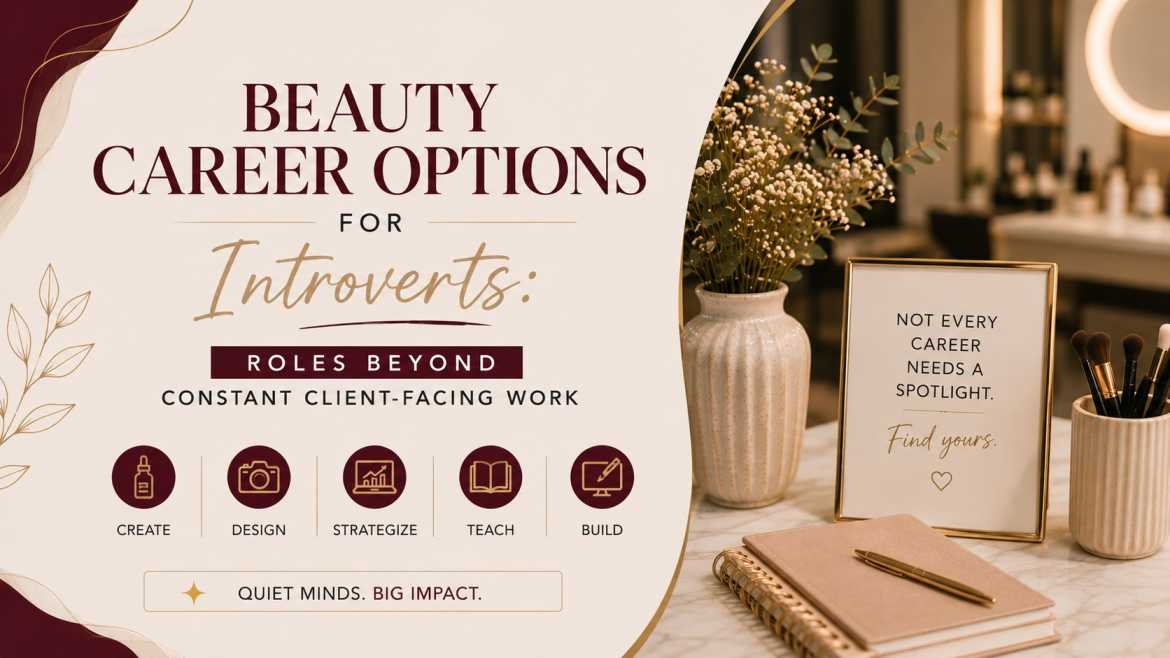
A lot of people rule out a beauty career for one specific reason: they imagine standing behind a chair, making non-stop small talk with a new stranger every forty-five minutes, all day long. For some people, that sounds energising. For others, it sounds exhausting before the workday has even started. Here’s what doesn’t get said enough: that image is only one version of a beauty career, not the whole industry. There are real, well-paying paths in beauty built around focus and precision rather than constant conversation. This guide walks you through some beauty career options for introverts properly.
Introvert Doesn’t Mean Unsuited to Beauty
Being an introvert isn’t about being shy or bad with people. It’s usually about where your energy comes from and how much social interaction feels draining over a long day. A lot of beauty work is actually well suited to that, because it’s hands-on, detail-focused, and often quiet by nature, even in roles that do involve clients.
Beauty Career Options for Introverts Where the Work Speaks Instead of Small Talk
Some client-facing beauty services naturally involve far less conversation than others, simply because of how the service works.
- Lash extensions and brow lamination: the client’s eyes are closed for most of the appointment, which naturally limits back-and-forth conversation compared to a facial or a haircut consultation
- Precision hair colouring and colour correction: this work demands intense focus on formula, timing, and sectioning, which naturally shifts the appointment toward concentration rather than chat
- Nail art and intricate nail design: detailed, seated, close-focus work where clients often expect quiet concentration rather than conversation
These roles still involve people, but the nature of the service itself creates natural quiet, rather than requiring constant performance.
Behind-the-Scenes Beauty: Film, TV, and Editorial Work
Backstage and on-set beauty work looks glamorous from the outside, but the actual working style is very different from a walk-in salon floor.
- Work runs off a call sheet and a schedule, not an unpredictable stream of new walk-in clients
- Actors, models, and performers often focus on their own preparation, which means the mood on set tends to be quiet and task-focused rather than chatty
- The work is heavily technical: matching continuity between shots, working fast under time pressure, and solving problems precisely, which rewards concentration over conversation
This path usually requires building a strong portfolio and industry connections first, but it’s a genuinely realistic direction for someone who prefers focused, project-based work over daily client rotation.
Product-Side Careers: R&D, Quality Control, and Formulation
Not every beauty career happens on a salon floor. The people trained in beauty science develop, test, and refine products.
- Formulation and research roles at cosmetic and skincare brands, often requiring additional study in cosmetic science or chemistry alongside a beauty background
- Quality control and lab testing roles, checking that products meet safety and performance standards before they reach shelves
- Regulatory and compliance roles, making sure product claims and ingredient lists meet legal requirements, which suits someone who’s detail-oriented and comfortable with documentation
These roles trade client interaction for a lab or office environment, and they reward the same ingredient knowledge that a strong beauty education already builds.
Teaching and Technical Training Roles
Once a professional has real hands-on experience, teaching is a structured, scheduled alternative to daily client work.
- Training junior students on technique inside a beauty academy, working with a set class and curriculum rather than a constantly rotating stream of strangers
- Running technical workshops or certification prep sessions, which involve people but in a planned, predictable format rather than unpredictable walk-ins
- Developing curriculum or training materials, which leans more into writing and structuring content than live interaction
Content, Documentation, and Brand-Side Roles
Beauty brands need people who understand the technical side of the industry but don’t necessarily need to be in front of clients all day.
- Technical content writing for beauty brands, explaining ingredients, routines, and product use in a way that’s accurate, not just marketing copy
- Visual merchandising and product styling, working with how products are displayed and photographed rather than applied on a client
- Social media and content creation for a brand’s education-focused platforms, which uses beauty knowledge without requiring live, ongoing client sessions
At LTA School of Beauty, students explore the full range of career paths a beauty education can lead to, not just salon floor roles. Through understanding how technical, product-side, and teaching careers each use the same foundational training differently, they are able to confidently choose a path that actually fits how they work best.
Frequently Asked Questions
Can an introvert actually succeed as a hairstylist or makeup artist?
Yes. Many introverts do well in these roles because the work itself needs focus and is hands-on. What matters more is choosing a service style, like precision colour or lash work, that naturally involves less constant conversation.
What are some of the best beauty career options for introverts?
Product-side roles like formulation, quality control, and regulatory compliance involve the least direct client contact, since the work happens in a lab or office environment rather than on a salon floor.
Do product-side beauty jobs require a science background?
Often yes, particularly for formulation and R&D roles, which usually need additional study in cosmetic science or chemistry. Quality control and compliance roles are more accessible with strong attention to detail and product knowledge.
Is backstage or film makeup work less social than salon work?
It’s differently social. The environment is usually quieter and more task-focused, working off a schedule rather than constant new walk-in clients, though it still requires strong communication with the production team.