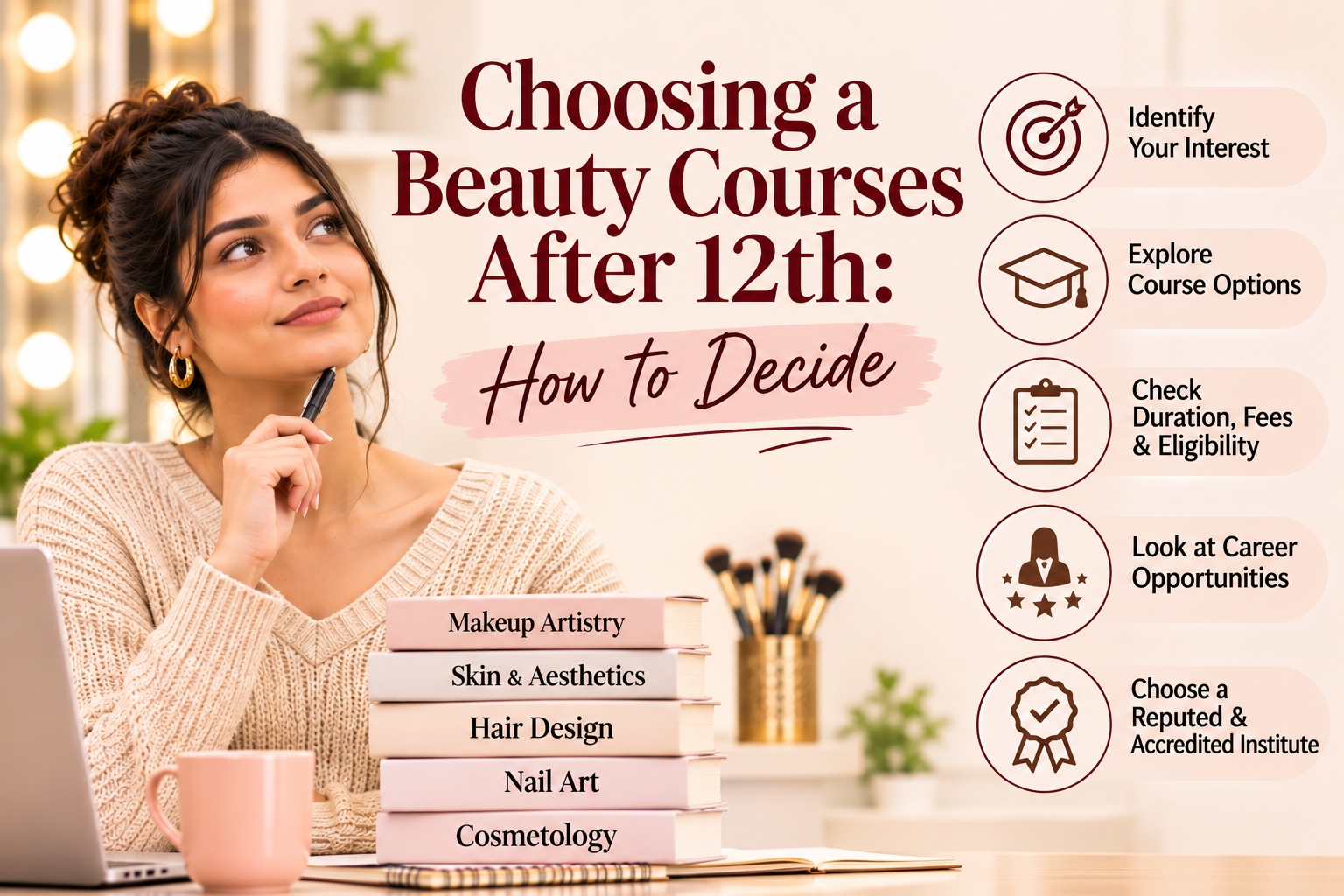
After 12th, most career conversations sound the same: engineering, medicine, commerce, law. Beauty rarely makes the list at home, even though it is one of the few fields where you can start earning with a skill, not just a degree. So if you are curious about it, you are not choosing the “easy” route. You are choosing a different one. So what are the best beauty courses after 12th? There is no single best course. The right one depends on the career you want: makeup artistry, hair, skin care, nails, spa therapy, salon management or teaching. In India, most routes fall into three types: short certificates, diplomas and degree programmes. Each leads to different jobs, takes a different amount of time and suits a different goal.
The Three Main Routes
| Route | Typical duration | Best for | What to know | |
| Certificate courses | A few weeks to a few months | Learning one skill quickly, such as makeup, nails or basic hair | Fast and affordable, but narrow. Quality varies a lot between institutes | |
| Diploma courses | Several months to a year or more | Building a solid, job-ready base in a field like beauty therapy, hair or cosmetology | The most common route. Check the curriculum, practical hours and approvals | |
| Degree programmes | Typically three years | Students who want a degree, wider career options or management and teaching routes | Offered by some universities and colleges. Verify the university’s approval, and check what the course actually teaches |
Course names, durations and eligibility differ between institutes, so always read the current brochure and ask for the syllabus in writing.
Courses By Career Goal
If you want to be a makeup artist
Look for a course with plenty of hands-on practice on different faces and skin tones. Bridal, party, editorial and media makeup are different skill sets, so check which ones the course covers. A strong portfolio matters as much as the certificate. See our makeup portfolio post.
If you want to work with hair
Hair courses cover cutting, colouring, styling and treatments. Ask how much time is spent on real clients, whether trichology basics are included and how technical topics like colour theory are taught. Our post on haircutting fundamentals shows the kind of skills a good course should build.
If you want to work in skin care and facials
Look for training in skin science, facials, skin analysis, hygiene and consultation. Courses vary in how much they cover advanced devices. Know that diagnosing skin disease and prescribing medicines belong to doctors, as explained in our skin clinic careers post.
If you want to work in nails
Nail courses teach manicures, pedicures, gel, acrylic and nail art. Hygiene and safety training is essential. See our nail hygiene and safety post.
If you want to work in spa and wellness
Look for courses covering massage, body therapies, spa operations and customer service. Spa roles can lead to hotel, resort and cruise careers, as in our cruise ship careers post.
If you want to manage or own a salon
Choose a programme that includes business basics, pricing, team handling and customer retention, alongside technical skills. Many people first train in a craft, work for a few years and then move into management or ownership.
If you want to teach or train
Beauty educator and trainer roles usually need strong technical skills, industry experience and often a teaching qualification or a track record. Start with a solid skills course, and build experience first.
What Jobs These Courses Can Lead To
- Makeup artist, freelance or salon-based
- Hair stylist or colourist
- Beauty therapist or aesthetician
- Skin therapist in a salon or clinic
- Nail technician or nail artist
- Spa therapist
- Bridal specialist
- Salon manager or front-desk lead
- Beauty advisor or product specialist for a brand
- Trainer or educator
- Content creator or blogger, alongside a skill. See our creator vs professional post.
- Salon, studio or academy owner, with experience
A note on the word “cosmetologist.” In India, it sometimes means a non-medical practitioner with a diploma, and sometimes a doctor who practises cosmetic dermatology. A beauty course does not make you a medical professional. If you want medical or clinical skin careers, that is a separate path through medical education.
What About Earnings?
Earnings depend on your city, skill level, employer, reputation and how you work. Freelancers, salary employees and business owners earn in very different ways, as our freelance vs salon post explains. A fresher usually starts lower and grows with experience, speciality and a strong client base. Instead of trusting a figure from an advertisement, ask for real examples from past students, and check job posts in your city.
Eligibility: Who Can Join?
Many certificate and diploma courses accept students who have passed 10th or 12th, but eligibility differs by institute and programme. Degree programmes typically need 12th pass, and some have subject or entrance requirements. Check the exact eligibility, age limits and documents for the course you are considering.
How To Choose A Course: A Simple Checklist
- Know your goal. Makeup, hair, skin, nails, spa or management? Pick a direction, even if it changes later.
- Read the syllabus. What exactly will you learn, and how many hours are practical?
- Check approvals.
- For a degree: is the university recognised, and is the programme approved?
- For a skill course: is it linked to a recognised body or skill framework?
- For an international qualification: is the centre approved by the awarding body? See our international qualification post.
- Ask about assessment. How will you be tested, and what happens if you fail? See our assessment post.
- Meet the trainers. What is their industry experience?
- Visit the institute. Look at the training space, tools, hygiene and how many students share one model or station.
- Get the full cost in writing. Fees, kits, exams, re-assessment and certificate charges.
- Talk to past students. Where do they work now? Would they choose the same course again?
- Ask about placement support honestly. Help with interviews and introductions is useful. Guaranteed jobs are a warning sign.
Red Flags
- Promises of guaranteed jobs or very high salaries
- Pressure to pay in full immediately
- No clear syllabus or fee breakdown
- Very large batches with little hands-on time
- Certificates from organisations you can’t verify
- Trainers who can’t show real industry work
- Poor hygiene in the training area
Certificate, Diploma Or Degree: How To Decide
- Choose a certificate if you want to test the field, add one skill or start earning quickly.
- Choose a diploma if you want a solid, job-ready foundation in one area.
- Choose a degree if you want a university qualification, a broader curriculum and flexibility, and you are comfortable with a longer timeline.
- Combine routes. Many people start with a diploma, work for a year or two and then add a specialised certificate once they know their direction.
Our August posts on choosing a course, diploma vs certificate vs degree and beauty education ROI go deeper into this decision.
A Message For Parents
Beauty is a legitimate profession with real career growth, from skilled specialist to educator to business owner. The best way to support a student is to check the course together: approvals, syllabus, trainers, costs and what past students do now. A good institute will welcome the questions.
At LTA School of Beauty, students build hands-on skills, hygiene habits and professional confidence that prepare them for careers in beauty, hair, skin care and wellness, in India and abroad. By learning how different qualifications and career paths fit together, they are able to choose a route that matches their strengths and plan their next steps with confidence.
FAQs
Which beauty course is best after 12th?
There is no single best course. The right one depends on your goal: makeup, hair, skin care, nails, spa or salon management. Compare the syllabus, practical hours, trainers, approvals and total cost, and choose the course that matches the career you want.
Can I do a beauty course after 12th in India?
Yes. Many certificate and diploma courses accept students who have passed 12th (and some accept 10th), and degree programmes usually need 12th. Eligibility differs by institute, so check the exact requirements before applying.
Is a certificate, diploma or degree better for a beauty career?
It depends on your goal. Certificates are short and focus on one skill, diplomas build a job-ready base and degrees offer a broader, university-level qualification. Employers also look closely at practical skill and portfolio, so training quality matters as much as the level.
How do I know if a beauty course is genuine?
Ask for the syllabus, approvals and fee breakdown in writing, and verify any affiliation or awarding body directly. Visit the institute, meet the trainers and speak to past students. Be careful with guaranteed jobs, pressure to pay quickly and certificates you can’t verify.