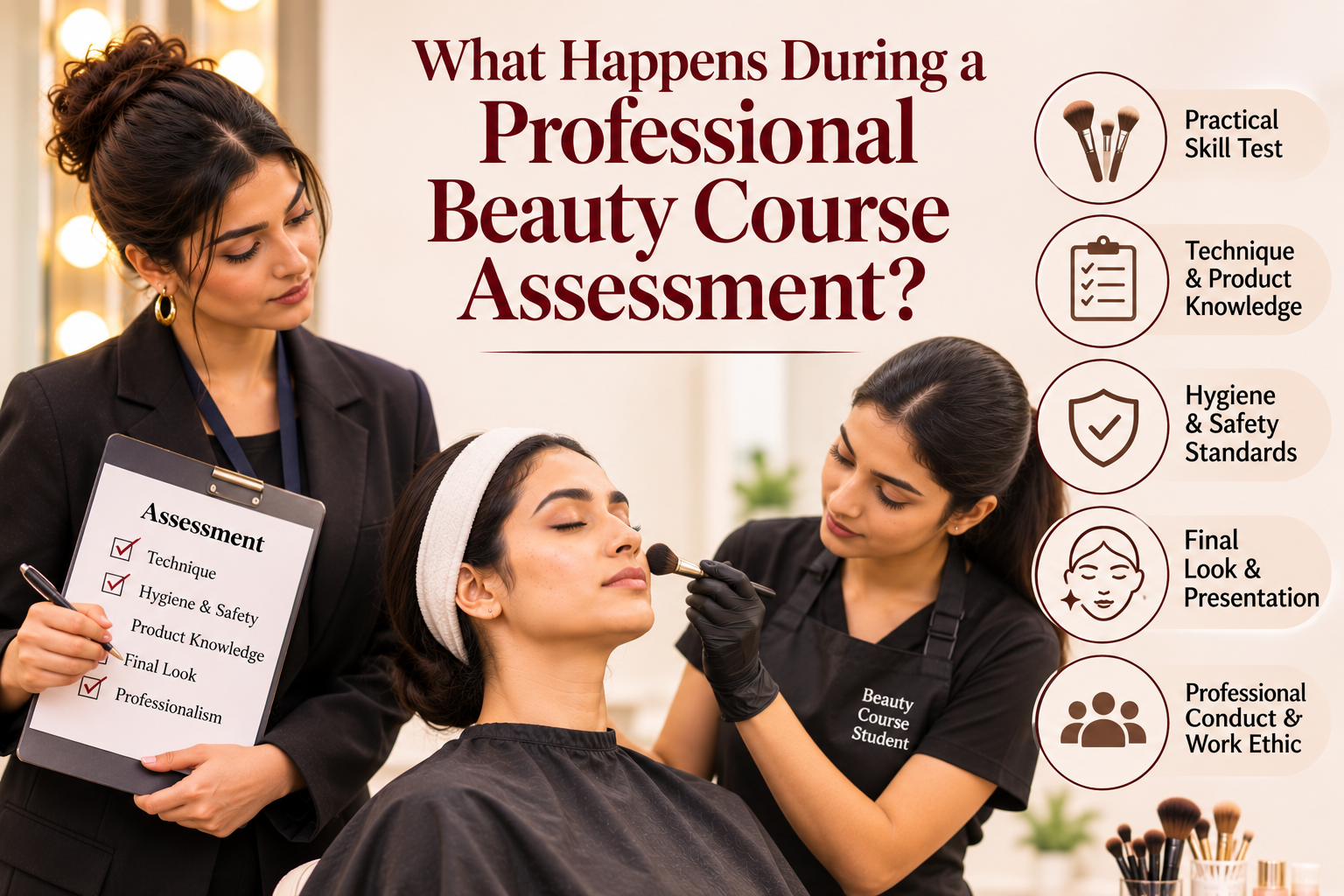
Ask a beauty student what scares her most, and it is rarely the course itself. It is the day someone stands behind her with a clipboard and watches her work. Not knowing what that day looks like makes it worse. So, what happens in a professional beauty course assessment? You are usually tested in more than one way: a practical assessment where an assessor watches you perform a service on a real or model client, a written or online theory test, and often a portfolio or log of the work you have done. The assessor is checking skill, safety, knowledge and professional behaviour, not just a pretty result.
Why Students Are Assessed In Several Ways
A beauty career needs more than neat hands. You need to know the science, follow safety rules, talk to clients and work to a standard. One test cannot show all of that, so most courses use a mix.
Formats vary by school and awarding body, so check your course handbook. But most assessments include some combination of the following.
1. Practical Assessment
This is the part students worry about most. You perform a service, such as a facial, a makeup application, a manicure, a haircut or a waxing treatment, while an assessor watches and marks you against set criteria.
What usually happens
- Preparation: You set up your workstation, check your tools and products, and sanitise. Assessors often watch this closely. In many courses, it counts as part of the result.
- Consultation: You greet the client, check for contraindications, record details and agree the plan. Skipping or rushing this can lose marks, even if the service looks great.
- The service itself: You work through the treatment in a sensible order, following the method you were taught and keeping to time.
- Aftercare and closing: You give advice, record the service and clean down.
- Feedback: Some assessors share comments straight away. Others give written feedback later.
What assessors look for
| Area | What it means in practice |
| Hygiene and safety | Clean hands, sanitised tools, safe posture, correct handling of products and waste |
| Consultation | Good questions, checking contraindications, recording details, getting consent |
| Technique | Correct method, accuracy, control and consistent pressure or product use |
| Time management | Finishing within the set time without rushing quality |
| Client care | Comfort, communication, modesty and respect |
| Result | A finish that meets the standard for that service |
| Professionalism | Appearance, behaviour, preparation and confidence |
Notice that the final look is only one row. Many students lose marks on safety and consultation, not on technique.
2. Theory Assessment
Theory tests check the knowledge behind your practical work. Depending on the course, this could be:
- Multiple-choice questions
- Short written answers
- Longer written questions
- Online tests, taken on a computer or tablet
- Oral questions during the practical session
Common topics
- Anatomy and physiology of skin, hair or nails
- Product knowledge and ingredients
- Contraindications and when to refer to a doctor
- Health, safety and hygiene rules
- Client consultation and records
- Treatment steps, tools and aftercare
- Professional conduct and the salon environment
Some schools ask about the “why” behind a step, not just the “what.” A student who can explain why a patch test is needed shows more understanding than one who only memorised that it is done.
3. Portfolio, Case Studies And Logbooks
Many courses also ask you to build evidence of your work over time.
- A treatment log: A record of services you have performed, often with client details, dates and signatures
- Case studies: A detailed write-up of one client, including consultation, treatment, results and what you would change
- Photographs, with the client’s written consent
- Assignments or projects, such as a product comparison or a hygiene plan
This shows how you work across weeks and months, not just on one stressful day.
4. Quality Checks Behind The Scenes
You may not see this, but good courses check that assessments are fair. Another member of staff may sample marked work, and in some systems an external verifier from the awarding body reviews it. This protects the value of your certificate. Ask your school how marking is checked.
What a typical practical exam day looks like
- Arrive early with your kit, uniform and documents.
- Check in with the assessor, and confirm the service, time and rules.
- Set up your workstation and prepare your products.
- Greet your model, and begin the consultation.
- Perform the service while the assessor observes quietly.
- Finish, clean and record.
- Wait for feedback or results, which may come that day or later.
If you can, visit the exam room beforehand, so the space is not a surprise.
How To Prepare
Know the criteria
Ask for the assessment criteria or marking sheet. It tells you exactly what the assessor will check. Many students prepare for the service and forget the rest.
Practise the full sequence, not just the treatment
Run through a whole session from greeting to aftercare, with a timer. Ask a friend or classmate to play the assessor and use the real marking sheet.
Practise on different people
Models vary in skin, hair, nails and comfort. Practising on a range helps you adapt calmly.
Prepare your kit the day before
- Check that every tool is clean and complete
- Pack backups, such as spare disposables
- Check your uniform, name badge and documents
- Know your model’s arrival time and details, if you are bringing one
Study theory actively
Use flashcards, practise questions and explain topics aloud to someone else. Focus on contraindications, hygiene rules and anatomy, since these often appear in both theory and practical questions.
Rest and eat
Sleep, water and food matter more than a last-minute cram session.
On The Day: Tips From Experienced Assessors
- Stay calm and steady. A small mistake handled well is better than a hidden mistake.
- Talk through your steps if you are allowed or asked. It shows understanding.
- Do not rush. Time pressure is real, but accuracy counts.
- Keep your area tidy throughout, not just at the end.
- Ask your model to relax, and check their comfort.
- If something goes wrong, such as a spill, a broken tool or a nervous model, stay professional and fix it calmly. Assessors often watch how you handle problems.
- Listen to instructions from the assessor, and follow the rules about talking, timing and help.
Common Reasons Students Lose Marks
- Missing or rushed consultation
- Ignoring a contraindication
- Poor hygiene or an untidy workstation
- Not checking skin or nails for infection
- Running out of time
- Missing steps in the sequence
- Using the wrong product or amount
- Not recording the treatment
- Forgetting aftercare advice
- Nervous behaviour that affects client comfort
What If You Don’t Pass First Time?
It happens, and it is not the end. Most courses allow a re-assessment, sometimes with limits or fees, so check your school’s policy.
- Ask for specific feedback. Which criteria did you miss?
- Practise those areas, instead of repeating everything.
- Ask for extra support, such as a practice session with a trainer.
- Book the next attempt when you feel ready, not just as soon as possible.
Many successful professionals needed a second attempt. What matters is that you learn from it.
After Assessment
- Your results, certificate or transcript will follow, depending on the course.
- Keep copies of your records and portfolio.
- Use your results to see where you are strong and where you want more practice.
- Start building your own portfolio of real client work. See our makeup portfolio post.
At LTA School of Beauty, students are prepared for assessment through hands-on practice, clear feedback and training in consultation, hygiene and professional conduct. By understanding what is expected and practising the full service from greeting to aftercare, they are able to approach assessments with confidence and show the skills employers look for.
FAQs
How is a beauty course assessed?
Most beauty courses use a mix of practical assessments, where an assessor watches you perform a service, theory tests on knowledge such as anatomy and hygiene, and a portfolio or treatment log. Exact formats depend on the school and awarding body, so check your course handbook.
What do assessors look for in a beauty practical exam?
They look at hygiene and safety, consultation and consent, technique, time management, client care, the final result and professional behaviour. A good-looking result alone is not enough if safety or consultation steps are missed.
How should I prepare for a beauty practical assessment?
Get the marking criteria, practise the full sequence from consultation to aftercare against a timer, practise on different models, prepare your kit the day before and study the theory behind each step. Rest well before the day.
What happens if I fail a beauty course assessment?
Most courses allow a re-assessment, though rules and fees vary. Ask for feedback on which criteria you missed, practise those areas, get extra support from a trainer and book the next attempt when you feel ready.