
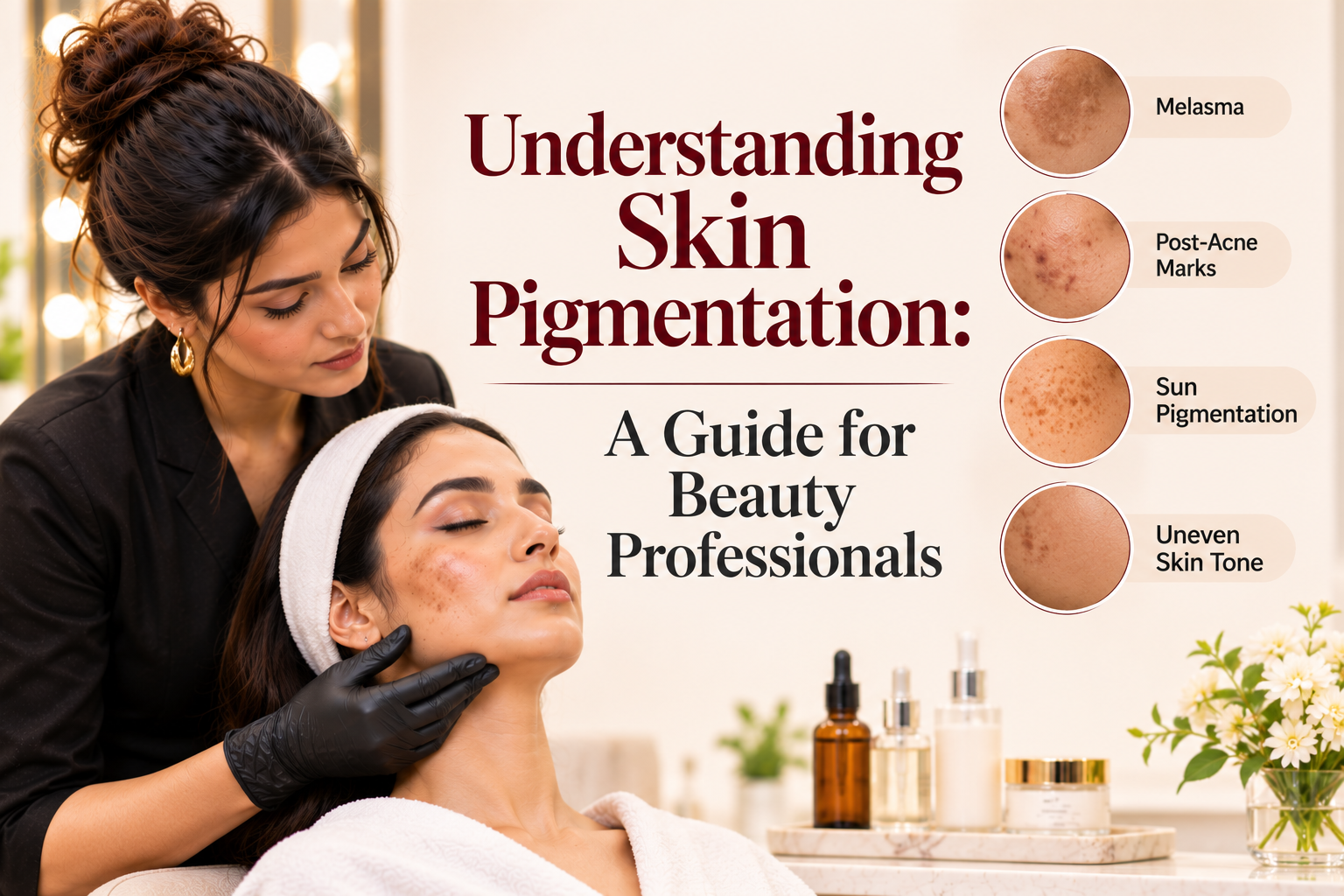
“Can you remove these dark spots?” It might be the most common question in a skincare consultation in India. Clients bring it with hope, and sometimes with a screenshot of a product that “cleared everything in two weeks.” Your answer has to be both kind and honest, and it starts with knowing what kind of pigmentation you are looking at.
So what is skin pigmentation? It is the colour of the skin, produced by a pigment called melanin. Pigmentation problems appear when melanin is made or spread unevenly, causing darker patches (hyperpigmentation) or lighter ones (hypopigmentation). Some are cosmetic and manageable with gentle care and sun protection. Others need a doctor.
How Skin Gets Its Colour
Special cells called melanocytes sit in the deepest layer of the epidermis. They make melanin and pass it to surrounding skin cells, where it forms a protective cap over the cell’s nucleus. Melanin absorbs and scatters UV light, which is how skin defends itself from sun damage.
Two things matter here:
- Everyone has about the same number of melanocytes. Skin tone depends on how much melanin they make and what type, not on how many cells there are.
- Melanocytes react to triggers. UV light, inflammation, hormones and some medicines can make them produce more melanin, sometimes unevenly.
Deeper skin tones have more active melanocytes. This gives natural sun protection, but it also means the skin is more likely to form dark marks after any injury or irritation.
Hyperpigmentation Vs Hypopigmentation
| Hyperpigmentation | Hypopigmentation | |
| What it is | Areas darker than the surrounding skin | Areas lighter than the surrounding skin |
| Cause | Excess melanin | Reduced or absent melanin |
| Common examples | Melasma, sun spots, post-inflammatory marks, freckles | Vitiligo, post-inflammatory lightening, some fungal skin conditions |
| Professional’s role | Assess, protect, gentle care, refer when needed | Do not treat. Refer for diagnosis |
The Main Types Of Hyperpigmentation
1. Post-inflammatory hyperpigmentation (PIH)
Dark marks left after skin is inflamed or injured. Common causes are acne, picking spots, burns, insect bites, waxing irritation, harsh peels and eczema. The mark can be brown, grey-brown or reddish, and it appears where the skin was irritated. On deeper skin tones, PIH is very common and can last for months.
2. Melasma
Brown or grey-brown patches, usually on the cheeks, forehead, upper lip and nose, often in a fairly symmetrical pattern. It is more common in women and is linked to sun exposure, hormonal changes (such as pregnancy or some hormonal medicines) and genetics. Heat and visible light may also play a part. Melasma tends to come and go, and it often returns with sun exposure.
3. Sun spots (solar lentigines)
Flat, tan to brown spots that appear on areas with long-term sun exposure, such as the face, hands and shoulders. They become more common with age.
4. Freckles (ephelides)
Small, light-brown spots that darken in sun and fade in winter. They are usually harmless.
5. Other causes
Some medicines, skin conditions and body changes can darken the skin. If pigmentation appears suddenly or without a clear reason, a doctor should look at it.
Types Of Hypopigmentation
- Vitiligo: Well-defined white patches that appear when pigment cells are lost. It is a medical condition, not a beauty concern. Be respectful and sensitive, avoid commenting on the patches and refer if the client wants advice.
- Post-inflammatory hypopigmentation: Lighter patches after skin injury or inflammation.
- Fungal conditions: Some cause lighter or darker patches, often with fine scaling.
Pale patches can have several causes. Do not guess. Suggest a doctor.
What Triggers Or Worsens Skin Pigmentation
- UV exposure, the biggest factor. Even a short period can darken existing marks.
- Inflammation: Acne, irritation, over-exfoliation and picking
- Heat: Hot environments, saunas and steam can worsen melasma in some people
- Hormonal changes: Pregnancy, some contraceptives and hormonal conditions
- Friction: Rubbing, tight collars, scrubbing
- Some medicines and products, including fragranced or photosensitising ingredients
- Genetics and skin tone
Pigmentation On Indian Skin
Indian skin tones usually sit in the medium to deep range. Key points for professionals:
- PIH is very common. Even small irritation can leave a mark, so prevention matters more than correction.
- Aggressive treatments can backfire. Strong peels, harsh scrubs, rough extractions or overly hot waxing can inflame the skin and darken it.
- Redness may be harder to see, so ask about burning, itching and tightness.
- Dark circles and underarm, neck or knuckle darkening have many causes, including genetics, friction, tiredness and allergies. Not every dark area is “pigmentation” in the same sense.
- Sun protection is non-negotiable. Without it, marks keep returning.
- Visible light, such as light from the sun and screens, may worsen melasma on deeper skin. Tinted sunscreens containing iron oxides can offer extra protection. Our sunscreen post covers SPF and PA ratings.
What A Beauty Professional Can Do
Within your training and scope, you can:
1. Consult properly. Ask when the pigmentation started, whether it changed, what triggers it, what products she uses, any medicines, pregnancy or breastfeeding, and any skin treatments she has had.
2. Look closely. Check colour, shape, borders, texture, symmetry and location. Is the skin broken, inflamed or irritated?
3. Protect first. Daily broad-spectrum sunscreen with high UVA protection is the foundation. Reinforce hats, shade and reapplication.
4. Calm and support the skin barrier. Gentle cleansing, hydration and soothing facials help prevent more inflammation. See our skin barrier post.
5. Avoid triggers in the treatment room. Skip strong exfoliation, heat-heavy services and aggressive extractions on pigmentation-prone skin.
6. Set realistic expectations. Pigmentation usually fades slowly, over weeks or months, and it can return. Do not promise a fixed timeline or total removal.
7. Recommend products carefully. Suggest sensible, gentle routines, introduce one active at a time and patch test. Avoid recommending strong or unregulated “lightening” creams, which can contain harmful ingredients.
What You Should Not Do
- Diagnose a type of pigmentation, especially melasma or vitiligo
- Promise “fairness” or whitening, which is an ethical issue as well as a practical one
- Use aggressive peels, scrubs or heat on pigmented or irritated skin
- Recommend or comment on prescription creams
- Sell mixed or unlabelled “whitening” products
- Ignore a changing mole or patch
When To Refer To A Doctor
Suggest a dermatologist if you see:
- A new dark spot or patch that appears suddenly
- A mole or spot that changes in size, shape, colour or border, bleeds, itches or does not heal
- A spot with uneven colour or irregular edges
- Widespread or worsening dark patches, especially on the face
- White patches or loss of colour
- Pigmentation that appears after starting a new medicine
- Patches that burn, itch or look inflamed
- Pigmentation that is affecting the client’s confidence or mental wellbeing
A dermatologist can diagnose the cause, check for conditions that need attention and offer treatment options. Referring protects the client, and it makes clients trust you more.
A Simple Pigmentation Care Plan To Share
- Wear sunscreen every day, and reapply
- Keep the skin barrier healthy with gentle products
- Avoid picking, scrubbing and unnecessary irritation
- Introduce active ingredients slowly, one at a time
- Be patient. Check in after several weeks, not days
- See a doctor for stubborn, spreading or unusual patches
Common Mistakes To Avoid
- Treating all dark patches as the same
- Using strong treatments too soon
- Skipping sunscreen while “treating” pigmentation
- Promising quick results
- Using the same routine for melasma and acne marks
- Ignoring a mole that looks different
At LTA School of Beauty, students learn the science of skin care and how to apply it. Through understanding how melanin works and how pigmentation responds to sun, inflammation and treatment, they are able to give honest, gentle, evidence-based advice and know when a concern needs medical attention.
FAQs
What causes skin pigmentation?
Pigmentation comes from melanin, which is made by cells called melanocytes. Sun exposure, inflammation from acne or irritation, hormonal changes, some medicines and genetics can make these cells produce more melanin unevenly, causing darker patches. Loss of melanin causes lighter patches.
What is the difference between melasma and post-inflammatory hyperpigmentation?
Melasma is a patchy, often symmetrical darkening, usually on the cheeks, forehead and upper lip. It is linked to sun, hormones and genetics. Post-inflammatory hyperpigmentation (PIH) is a dark mark left where skin was inflamed or injured, such as after acne or irritation. A doctor can tell them apart.
Can a beauty professional treat pigmentation?
A professional can support skin with sun protection advice, gentle care and avoiding irritating treatments. Diagnosis and medical treatment belong to a dermatologist. Pigmentation is slow to fade, so avoid promising quick or total removal.
When should I see a dermatologist for dark spots?
See one if a spot or patch appears suddenly, changes in size, shape or colour, bleeds or itches, or if pigmentation is spreading, inflamed or not improving. White patches, and pigmentation after a new medicine, also need a doctor’s opinion.