
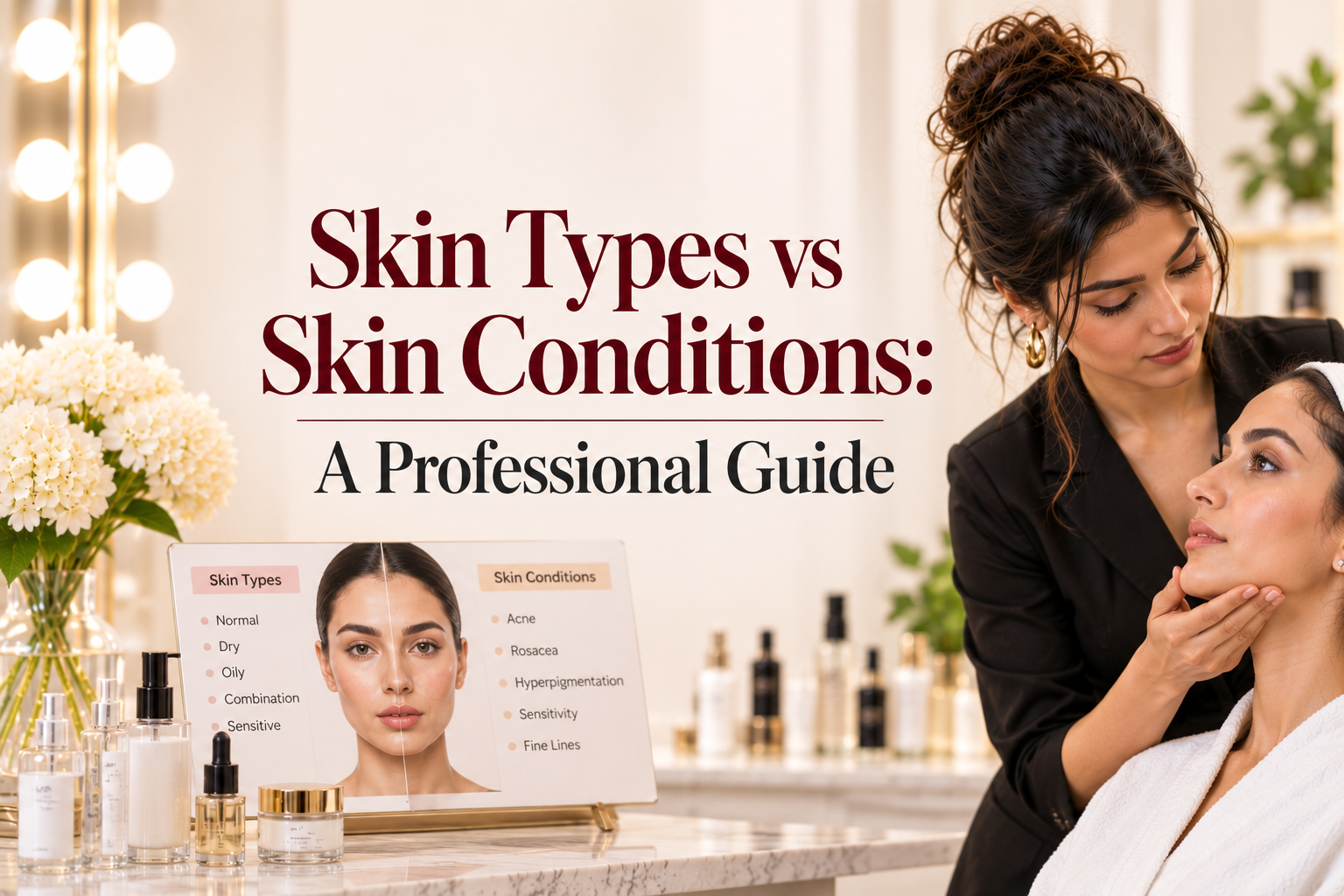
A client says, “I have dry skin.” Her face is tight and flaky, so you reach for a rich cream. A week later, she returns with breakouts. The problem was not dryness at all. Her skin was dehydrated, a different issue that needs a different fix. So what is the difference between a skin type and a skin condition? A skin type is how your skin naturally behaves, mostly decided by genetics and oil production. A skin condition is a state or disorder that can affect any skin type and may change over time or need medical care. Professionals who keep these apart choose safer, more accurate treatments.
The Three-Part Framework
Think of every client’s skin in three layers. Assessing each one separately prevents most mistakes.
| Layer | What it means | Examples | Changes? |
| Skin type | The skin’s natural baseline | Normal, dry, oily, combination | Slowly, with age and hormones |
| Skin state | Temporary condition of the skin right now | Dehydrated, sensitised, irritated | Often changes quickly |
| Skin condition or disorder | A recognised skin problem, sometimes medical | Acne, eczema, rosacea, psoriasis, melasma | May be long-term and may need a doctor |
A fourth word, skin concern, is what the client says bothers her, such as dullness, dark marks or large pores. A concern can have several causes, so treat it as the start of your questions, not the answer.
Part 1: Skin Types
Skin type is based mainly on how much oil (sebum) the skin makes.
Normal skin is balanced, neither too oily nor too dry, with small pores and few problems.
Dry skin produces less oil. It can feel tight, look rough or dull, and may flake. It lacks oil (lipids).
Oily skin produces more oil. It looks shiny, often has larger pores and is more prone to blocked pores and breakouts.
Combination skin is oily in some areas, usually the forehead, nose and chin (the T-zone), and normal or dry elsewhere.
Sensitive skin is often listed as a type, but many professionals treat it as a tendency or state. It reacts quickly to products, weather or friction with redness, stinging or itching. Since sensitivity can sit on top of any skin type, record it separately.
How to identify skin type
- Cleanse the face and wait about an hour without applying products.
- Look at the skin in good light, and notice shine, tightness and texture.
- Press blotting paper on different areas to see where oil shows.
- Ask about the client’s usual experience through the day.
Check again across seasons. Many people feel oily during humid months and dry in winter.
Part 2: Skin States
States are temporary and often fixable with good care.
Dehydrated skin lacks water, not oil. It can happen in any skin type, including oily skin. Signs include tightness, dullness, fine surface lines, and skin that looks tired despite oil on the surface.
Dry vs dehydrated: the key difference
| Dry skin | Dehydrated skin | |
| Lacks | Oil | Water |
| Type or state? | Type | State |
| Usual signs | Rough, flaky, tight most of the time | Tight, dull, fine lines, may still look shiny |
| Care focus | Oils, lipids, emollients | Humectants and water-binding ingredients, plus barrier support |
Sensitised or irritated skin reacts strongly because the barrier is stressed, often from over-exfoliation, harsh products or weather. See our skin barrier post for more.
Sun-damaged skin shows uneven tone, roughness and visible damage from repeated sun exposure. Daily sunscreen is the foundation of care.
Part 3: Skin Conditions
Conditions range from mild to medical. Beauty professionals should recognise them, support skin care where appropriate and refer when needed.
| Condition | What you may notice | Professional’s role |
| Acne | Blackheads, whiteheads, red bumps, deep lumps | Gentle care for mild cases, refer deep or severe acne |
| Eczema (dermatitis) | Dry, itchy, red or scaly patches, sometimes cracked or weeping | Do not treat. Avoid irritating services. Refer |
| Psoriasis | Thick, well-defined, scaly patches | Do not treat. Refer |
| Rosacea | Persistent facial redness, flushing, visible vessels, sometimes bumps | Gentle, soothing care only. Refer for diagnosis |
| Melasma and pigmentation | Brown or grey-brown patches, often on cheeks and forehead | Sun protection and gentle care. Avoid aggressive treatments. Refer |
| Vitiligo | White patches where skin has lost pigment | Not a beauty treatment issue. Be sensitive. Refer if the client wants advice |
| Fungal or bacterial infections | Itchy rings, pus, crusting, spreading rash | Do not treat. Do not use shared tools. Refer |
| Contact dermatitis | Red, itchy rash after touching a product or material | Stop the service. Refer |
You do not diagnose these conditions. You notice the signs, adjust or stop your service, and recommend a doctor. Our skin clinic careers post explains where a beauty professional’s scope ends.
Why Mixing Them Up Causes Problems
- Treating a state like a type. Giving heavy oils to dehydrated, oily skin can clog pores.
- Treating a condition like a type. Using harsh exfoliation on rosacea or eczema can make it worse.
- Calling every red patch “sensitive skin.” It could be a condition that needs a doctor.
- Assuming a dark patch is just tanning. It could be melasma, which needs careful management.
- Using one routine forever. Skin changes. A routine that worked at 20 may not suit 35.
Skin Tone Is Not Skin Type
Skin tone (how light or deep the skin is) and skin type (how oily or dry it is) are different things. A related scale, the Fitzpatrick scale, groups skin by how it reacts to sun, from type I to type VI. It helps with sun safety and some treatment decisions, but it does not describe oil balance or sensitivity.
For Indian skin, keep in mind:
- Skin often has a tendency toward pigmentation after irritation or inflammation, so avoid unnecessary aggressive treatments.
- Redness can be harder to see on deeper skin, so ask about burning, itching and tightness as well as how it looks.
- Sunscreen matters for every skin tone.
How To Run a Professional Skin Assessment
- Consult first. Ask about concerns, routine, products, medicines, allergies, recent treatments and health changes.
- Look and feel. Check skin in good light. Note oiliness, texture, redness, marks, pores and any broken skin.
- Identify the type, then the state. Is the skin oily, dry, combination or normal? Is it dehydrated or irritated right now?
- Check for conditions. Look for patterns that suggest a skin disorder, and ask how long they have lasted.
- Decide what is safe. Choose services and products that suit the skin today.
- Explain and record. Tell the client what you found in plain words, and write it down.
When To Refer
Suggest a doctor or dermatologist if you notice:
- Patches that are scaly, thick, cracked or weeping
- Persistent redness, burning or flushing
- Sudden or spreading rashes
- Moles or marks that change in size, shape or colour
- Signs of infection, such as pus, heat or fever
- Symptoms that do not improve with gentle care
- A condition that is affecting the client’s comfort or confidence
At LTA School of Beauty, students learn the science of skin care and how to apply it. Through understanding the difference between skin types, states and conditions, they are able to assess skin accurately, choose safe treatments and know when to refer a client for medical care.
FAQs
What is the difference between a skin type and a skin condition?
A skin type is the skin’s natural baseline, such as normal, dry, oily or combination. A skin condition is a specific problem, such as acne, eczema or rosacea, that can affect any skin type and may need medical care. Skin type is mostly stable, while conditions can come and go.
What is the difference between dry skin and dehydrated skin?
Dry skin lacks oil and is a skin type. Dehydrated skin lacks water and is a temporary state that can affect any skin type, including oily skin. Dry skin needs lipids and emollients, while dehydrated skin needs humectants and barrier support.
Is sensitive skin a skin type?
It is often listed as one, but many professionals treat it as a tendency or state that sits on top of another type. If a client has frequent redness, stinging or itching, consider whether a skin condition or a damaged barrier is involved, and refer if needed.
Can a beauty professional treat skin conditions like eczema or rosacea?
No. Beauty professionals can recognise signs and offer gentle, supportive care where appropriate, but diagnosis and medical treatment belong to a doctor. If you suspect eczema, psoriasis, rosacea or an infection, adjust or stop the service and refer the client.