
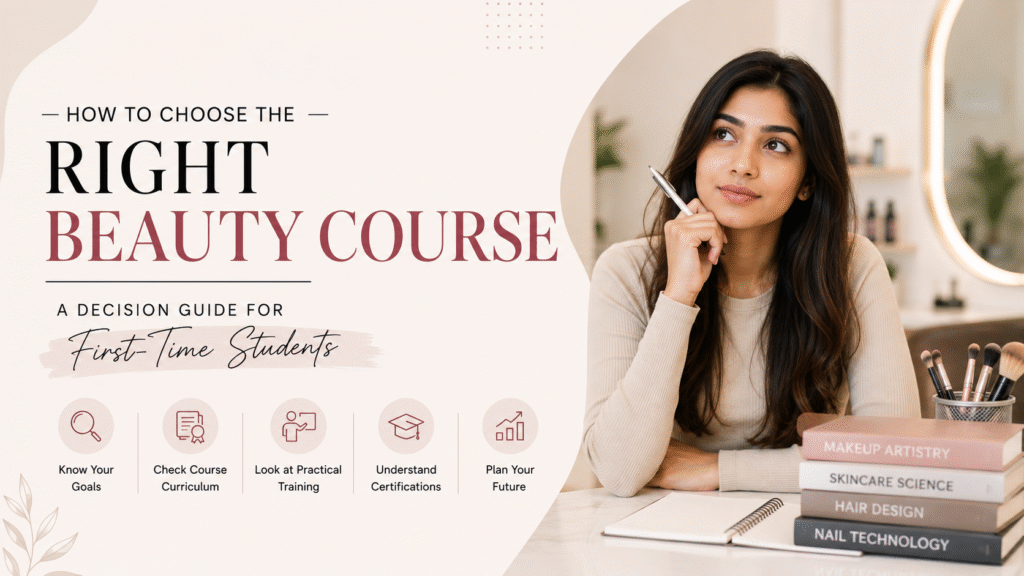
Most 12th-pass students researching a beauty career face the same issue within the first few attempts of searching. One website calls it a certificate course, another calls the same duration a diploma, a third lists it a degree that takes three years. Almost none of them explain why they’re different or which one actually suits a person’s situation. This confusion isn’t a small problem. Picking the wrong course level means either overpaying for depth you didn’t need yet. Or, it can mean underpaying for a course that doesn’t get you hired anywhere. This guide exists to walk through that decision properly, the way a counsellor should, rather than a brochure. Let’s delve into how to choose the right beauty course.
Start With What You Actually Want to Do, Not What Sounds Impressive
Before comparing course levels, get honest about which part of beauty actually interests you day to day. Skin therapy, hairdressing, makeup artistry, and nail technology are different jobs with different daily realities. They are not interchangeable specialisations under one umbrella.
Someone who loves the precision of skin analysis and treatment protocols will find a hairdresser’s client-facing job exhausting. Someone who thrives doing bridal makeup on a wedding morning will find long solo facial appointments slow.
A lot of first-time students enrol in a broad diploma because it feels safer. Two years later they discover that they only want to specialise in one of the four skills. Thinking about this question and shadowing a working professional for a day can save both money and a wasted year.
Certificate, Diploma, or Degree: What Each One Actually Commits You To
A certificate course
- It usually runs a few weeks to a few months
- It focuses on one specific skill such as basic facials or hair styling.
- Usually has little to no eligibility requirement.
- It’s the right choice if you want to test whether you enjoy the work before committing further, or if you need to start earning quickly and can build on it later.
A diploma
- It typically runs closer to a year, sometimes stretching to eighteen or twenty months for the more rigorous international ones.
- It covers a fuller curriculum across theory and hands-on practice.
- This is the level most salons actually expect to see on a hire’s resume.
A degree
- It runs three to four years, usually with built-in exit points, meaning a student can leave after year one with a certificate-equivalent and after year two with a diploma-equivalent if their circumstances change.
- The degree route matters most for students aiming past salon work, toward brand-side roles, beauty education, or product development, where a longer academic credential opens doors a diploma alone doesn’t.
Why the Certifying Body Matters More Than the Course Name
Two diplomas can look identical on paper and mean very different things depending on who actually certifies them.
A course affiliated with an internationally recognised body has to meet that body’s practical exam standards, not just the school’s own internal grading. Such external verification is what makes the qualification important if you ever want to work outside India.
A purely in-house diploma also has plenty of excellent training opportunities but without international affiliation. It’s crucial to know the difference going in rather than assuming every diploma carries the same weight in a hiring manager’s eyes.
The Ratio Question Almost Nobody Asks Before Enrolling
Ask any institute what percentage of the course is hands-on practice versus classroom theory, and ask to see an actual weekly timetable, not a marketing brochure’s rounded figure.
Beauty is a physical, muscle-memory skill, and a course that’s heavy on lecture time and light on supervised practice on real or model clients produces graduates who understand the theory but freeze in front of their first paying client.
A strong practical ratio is generally around 70% hands-on to 30% theory in well-run programmes. It is a reasonable benchmark to compare against.
What to Actually Verify Before You Pay a Rupee
Beyond the brochure, ask direct questions and expect direct answers.
- Who teaches the practical sessions?
- What’s their own industry background, not just their teaching tenure?
- What does the on-site lab or salon floor actually look like?
- Is the floor the same space shown in the promotional photos?
- What specific companies or salons has the institute placed graduates with in the last year? Enquire by name, rather than trusting a vague claim of guaranteed placement.
- Are fees broken down by module so you know exactly what you’re paying for, or bundled?
A hesitant or vague answer to any of these is worth taking seriously.
The Mistake Most First-Timers Make
The single most common error isn’t picking the wrong specialisation. It’s picking a course level based purely on price or how quickly it finishes. Also, not checking whether that level actually gets you hired for the work you want to do is a problem.
A cheap, fast certificate might feel like the safer financial choice at eighteen, but if the goal is a serious, long-term career rather than a stopgap skill, under-investing at the start usually means paying for a second, more expensive course later anyway.
At LTA School of Beauty, students get guidance on choosing the right specialisation and course level before they enrol. Through understanding how certificate, diploma, and international-diploma paths differ in depth, certification, and career ceiling, first-time students are able to confidently choose a path that matches where they actually want to be in five years, not just what looks good on a brochure.
Frequently Asked Questions
What’s the actual difference between a certificate and a diploma course in beauty?
A certificate usually covers one specific skill over a few weeks to months with little eligibility requirement. A diploma runs closer to a year, covers a fuller curriculum across multiple skills, and is what most salons expect to see when hiring.
Do I need a specific stream or percentage in 12th to join a beauty course?
Generally, no. Most certificate and diploma programmes in beauty don’t require a specific stream or minimum percentage, unlike degree-level programmes, which may have their own admission criteria.
Is an international certification like CIDESCO or VTCT worth the extra cost?
If the goal includes working abroad, at a premium salon, or building long-term credibility in the field, yes. These bodies enforce external practical exam standards, which makes the qualification portable in a way an in-house-only diploma isn’t.
How long does it actually take to become job-ready in the beauty industry?
It depends on the level chosen: a focused certificate can lead to entry-level work within a few months. A full diploma, typically closer to a year, is usually what’s needed for salons to consider a candidate fully trained across services.