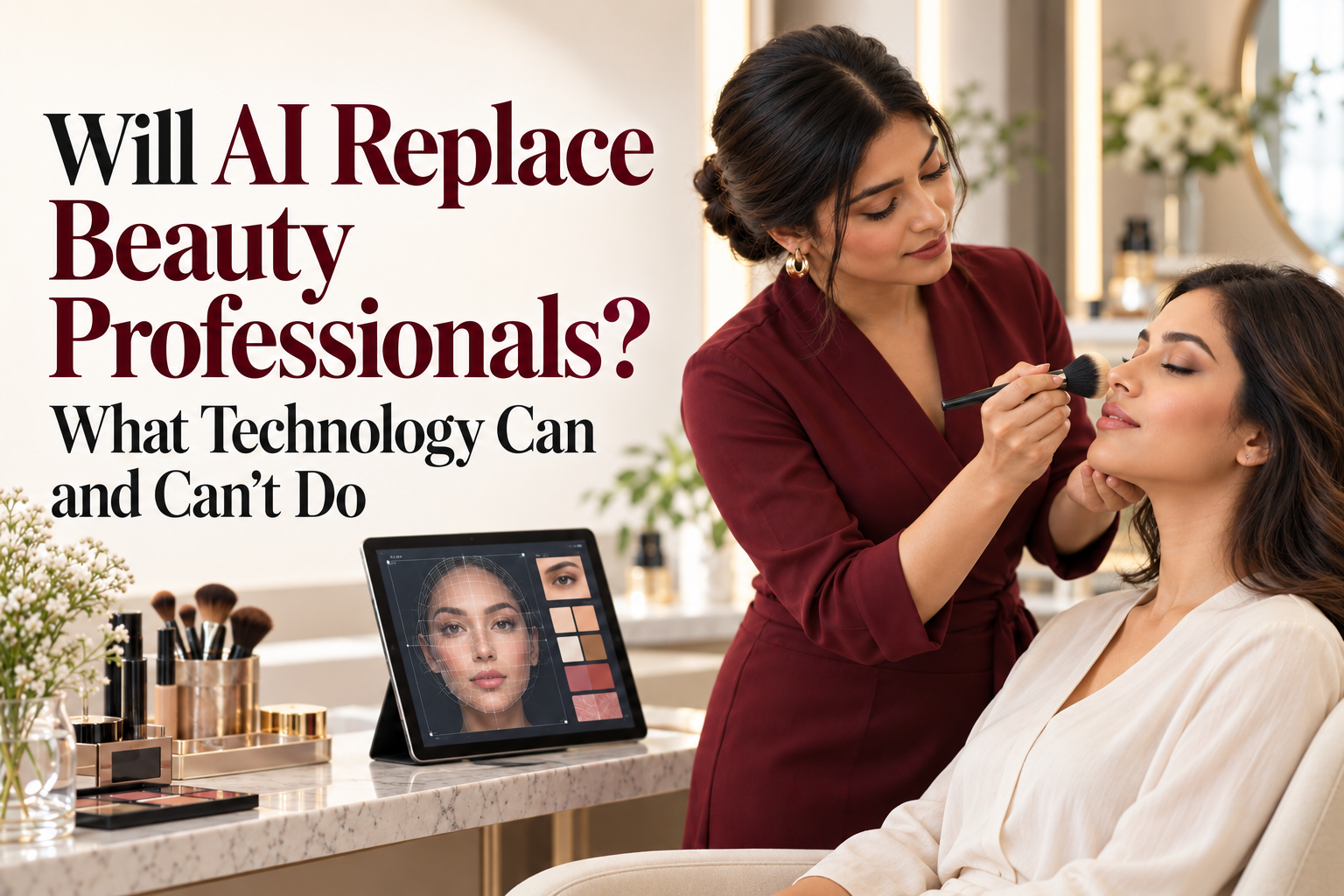
Open any beauty app today and it can scan your face, suggest a foundation shade, show you in a new hair colour and recommend a skincare routine. Some companies have even built robots that paint nails or place lashes. So the question is fair: is there a future for human beauty professionals? Will AI replace beauty professionals?
Short answer: AI will change parts of beauty work, but it is unlikely to replace the whole profession. Machines are good at analysis, suggestions and repetitive tasks. They are weak at touch, judgement, trust and handling a real person in a real room. Professionals who learn to work with technology will be in a stronger position than those who ignore it.
What AI And Technology Already Do Well
Be honest about this part. Ignoring it won’t help you.
- Virtual try-on. Apps let people test lipstick, hair colour and makeup looks on their own face before buying or booking.
- Skin analysis. Phone cameras and devices can scan skin and flag visible concerns like dryness, pigmentation or oiliness.
- Product recommendations. Online tools suggest products based on a few answers or a photo.
- Booking and admin. Chatbots, automated reminders and scheduling tools handle routine messages.
- Content and marketing. AI can help draft captions, edit photos and plan posts.
- Inventory and sales tracking. Software spots which products sell and when stock is running low.
- Some repetitive services. Robotic machines for nail polish application, lash extensions and massage have been launched by a few companies, mostly in limited settings.
These tools save time. They also raise client expectations, since people now arrive having already “tried” a look on their phone.
What Technology Can’t Do Well
1. It can’t touch
Beauty is physical. Pressure, speed and angle change by the second, based on how the client’s skin or muscles respond. A good massage therapist feels a knot and adjusts. A good stylist senses how hair behaves under the comb. Machines can follow set routines, but they struggle with the constant small judgements that human hands make.
2. It can’t read the room
A nervous bride, a client going through a hard week, someone who wants a big change but is scared of it. Professionals pick up on mood, body language and what a client isn’t saying. That shapes the whole service.
3. It can’t take responsibility
When a reaction happens or a result goes wrong, a client wants a person who can respond, fix it and take responsibility. An app can’t hold a consultation form, check a client’s history or decide to say “let’s not do this today.”
4. It can’t judge safety
AI skin scans can miss or misread conditions. They can’t replace a trained eye, a patch test or a referral to a doctor. A scan that calls something “mild” does not make it safe to treat.
5. It can be biased
Many AI tools have been trained on limited sets of images, and some work less well on certain skin tones and hair types. For a market as varied as India, a professional who understands undertones, textures and local conditions is still essential.
6. It can’t build trust over years
People return to the person who remembered their wedding, knew their skin and made them feel looked after. That relationship is hard to automate.
Role By Role: What Is Likely To Change
| Role | What technology can help with | What stays human |
| Makeup artist | Look previews, shade matching tools | Application on real faces, adapting to light, skin and mood |
| Hairstylist | Colour simulations, trend ideas | Cutting, colouring, texture and condition judgement |
| Skin therapist | Skin scans, progress photos | Assessment, treatment choice, safety and referral |
| Nail technician | Design previews, some automation | Nail health checks, detailed art, client care |
| Massage therapist | Booking, basic routines | Touch, feedback, therapeutic judgement |
| Salon manager | Scheduling, stock and sales tools | Team leadership, client relationships, problem solving |
| Educator | Learning tools, content creation | Demonstration, feedback, mentoring |
Which Tasks Are Most At Risk
Jobs rarely vanish all at once. Tasks change first. The parts most open to automation are the simple and repeatable ones:
- Basic product advice from a standard questionnaire
- Routine bookings and reminders
- Standard, simple services done the same way every time
- Basic content creation
If your work is only the routine part, you are more exposed. If your work includes judgement, adaptation and a personal relationship, you are far better protected.
What Clients Still Pay Extra For
- A real consultation, not a form
- A person who listens and adjusts
- Skill in difficult cases, like corrective colour or reactive skin
- A calm, hygienic, pleasant experience
- Someone who can explain why, not just what
- Premium, personalised service
As technology makes basic things easier to get, the value of expertise and human care tends to go up, not down.
How To Future-Proof Your Beauty Career
- Master the fundamentals. Technology is only as good as the person using it. Strong skin, hair and colour knowledge matters more than ever.
- Get great at consultation. Listening, questioning and explaining are hard to automate.
- Learn the tools. Try the apps clients are using. If you know what a scan can and can’t tell, you can guide clients properly.
- Specialise. Bridal work, curly hair, skin concerns, scalp care or men’s grooming. Specialists are harder to replace than generalists.
- Build a personal brand. Clients choose people, not just services.
- Keep learning. New techniques and products arrive every year. Treat training as ongoing.
- Develop business skills. Pricing, marketing and client retention protect your income.
- Keep hygiene and safety sharp. Trust in your practice can’t be outsourced.
How To Use AI Safely In Your Work
- Treat scans as a starting point, not a diagnosis.
- Be honest with clients about what tools you use and what they can and can’t show.
- Protect client data. Photos and skin details are personal. Ask for permission before uploading them anywhere, and check how the tool stores them.
- Check AI-generated content. Captions or advice drafted by AI can contain mistakes. Review before posting, and never post medical claims you can’t support.
- Don’t let a tool replace your judgement. If something looks wrong, trust your training.
Common Mistakes To Avoid
- Ignoring technology and hoping it goes away
- Trusting tools blindly and skipping your own assessment
- Competing on price for routine services
- Letting skills go stale
- Sharing client photos or details with apps without consent
- Panicking about every headline
At LTA School of Beauty, students build the hands-on skills, consultation habits and professional judgement that technology cannot copy. By learning how skin, hair and makeup actually work, they are able to use new tools with confidence while staying the trusted expert clients come back to.
FAQs
Will AI replace makeup artists and hairstylists?
It is unlikely to replace them fully. AI can preview looks, match shades and suggest ideas, but it can’t apply makeup, cut hair, read a client’s mood or adjust to a real face and real hair. Professionals who use technology as a tool are in a stronger position.
Which beauty jobs are most affected by AI?
Routine tasks are most open to change, such as basic product recommendations, scheduling and standard repetitive services. Roles that involve judgement, touch, safety and relationships, like skin therapy, bridal makeup and advanced hair work, are harder to automate.
Can AI skin analysis replace a skin therapist?
No. Skin scans can show visible patterns, but they can’t take a full history, check for allergies, judge safety or decide when to refer a client to a doctor. They work best as a support tool, not a replacement.
How can beauty professionals prepare for the future of AI?
Build strong core skills, improve consultation and client communication, learn what common beauty apps and tools can do, specialise in an area, build a personal brand and keep learning. Protect client data and use technology to support, not replace, your judgement.